Politics
Article04/29/2026
How West Bengal Has Voted: A Historical Vote Share Analysis

Mumbai last voted for its municipal corporation in 2017. Since then, despite the constitutional requirement of elections every five years for urban local bodies, the Brihanmumbai Municipal Corporation has remained without an elected house, largely due to delays arising from reservation and delimitation disputes. As the city moves closer to the next BMC election, the absence of recent municipal contests makes the 2017 election the only reliable empirical reference point for understanding how Mumbai actually behaves at the ballot box in local elections.
This report attempts to use that election as a structural reference point combining ward-level data with regional political intuition to examine how power is constructed, defended, and contested across Mumbai’s wards.
Mumbai’s municipal politics is not shaped by waves, citywide sentiment, or simple party dominance, rather by the fragmentation, narrow margins, and highly localised contests, where small shifts in mobilisation or vote division can decide outcomes. By unpacking these patterns, with a region-wise reading of Mumbai’s political geography today, the report aims to provide readers, voters, observers, and political practitioners alike with a clearer intuition of why BMC elections behave differently from Assembly or parliamentary contests, and what that difference implies for the upcoming election.
At first glance, the 2017 BMC result appeared almost bipolar. SHS (united) emerged as the single largest party with 84 seats, closely followed by the BJP with 82 seats, while INC lagged at 31 seats. Vote shares mirrored this proximity, with SHS (united) and BJP separated by less than one percentage point. But this near-parity conceals the most important reality of the election: no party truly dominated Mumbai.
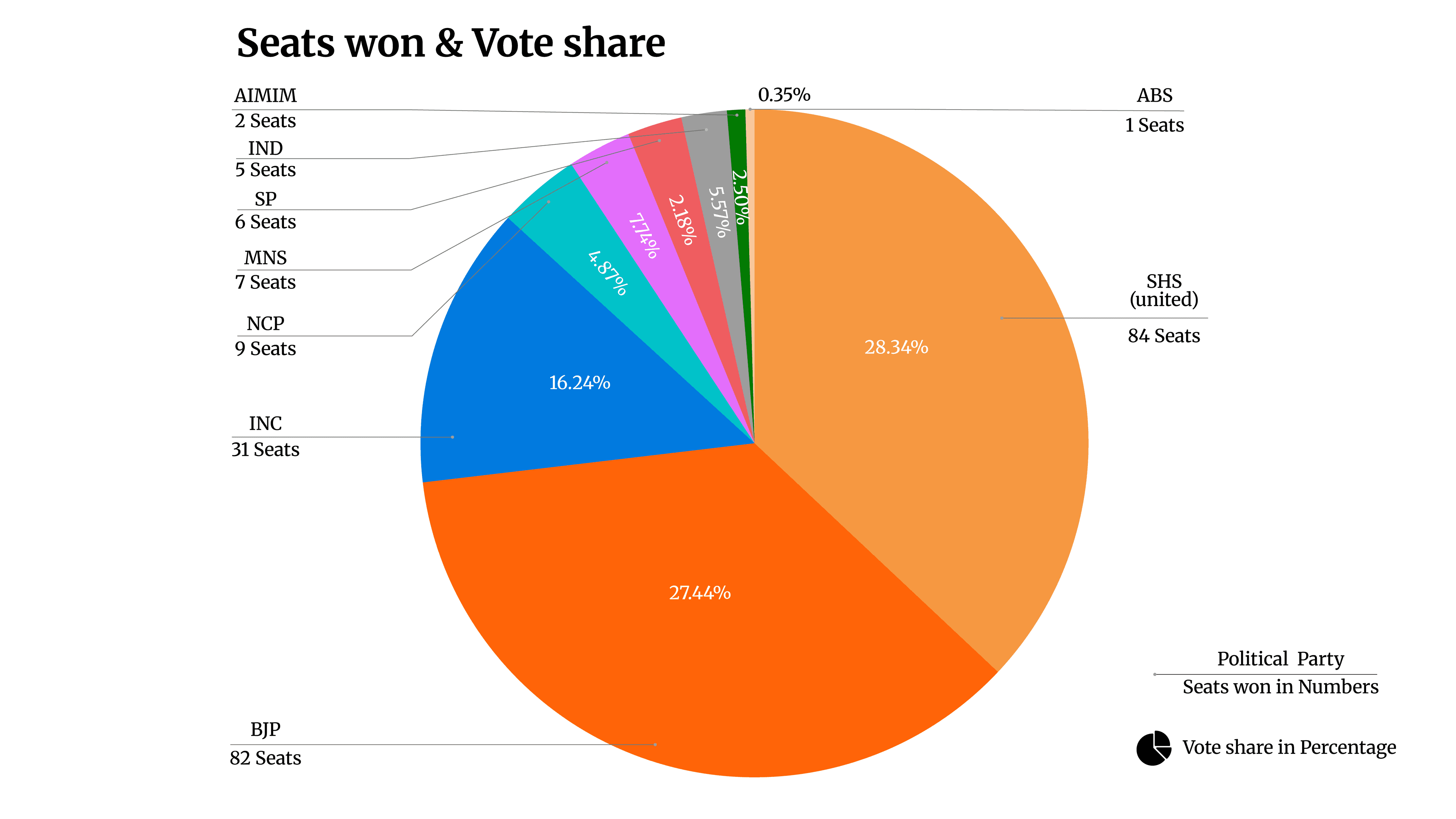
Control of the BMC was not the result of a citywide sentiment but rather the cumulative outcome of dozens of narrowly decided wards. The overall result was less about popularity and more about how effectively parties navigated fragmentation.
What looked like a two-party fight at the aggregate level was, in practice, a mosaic of small and highly localised contests.
The most consequential insight from the 2017 election is not who won, but how narrowly many wards were decided. When wards are classified by victory margins, a stark pattern emerges.
Almost half of Mumbai’s wards were decided by margins below 12%. A significant chunk of these were won by margins under 6%. Only 68 wards were won with margins above 18%, which can reasonably be described as secure victories.
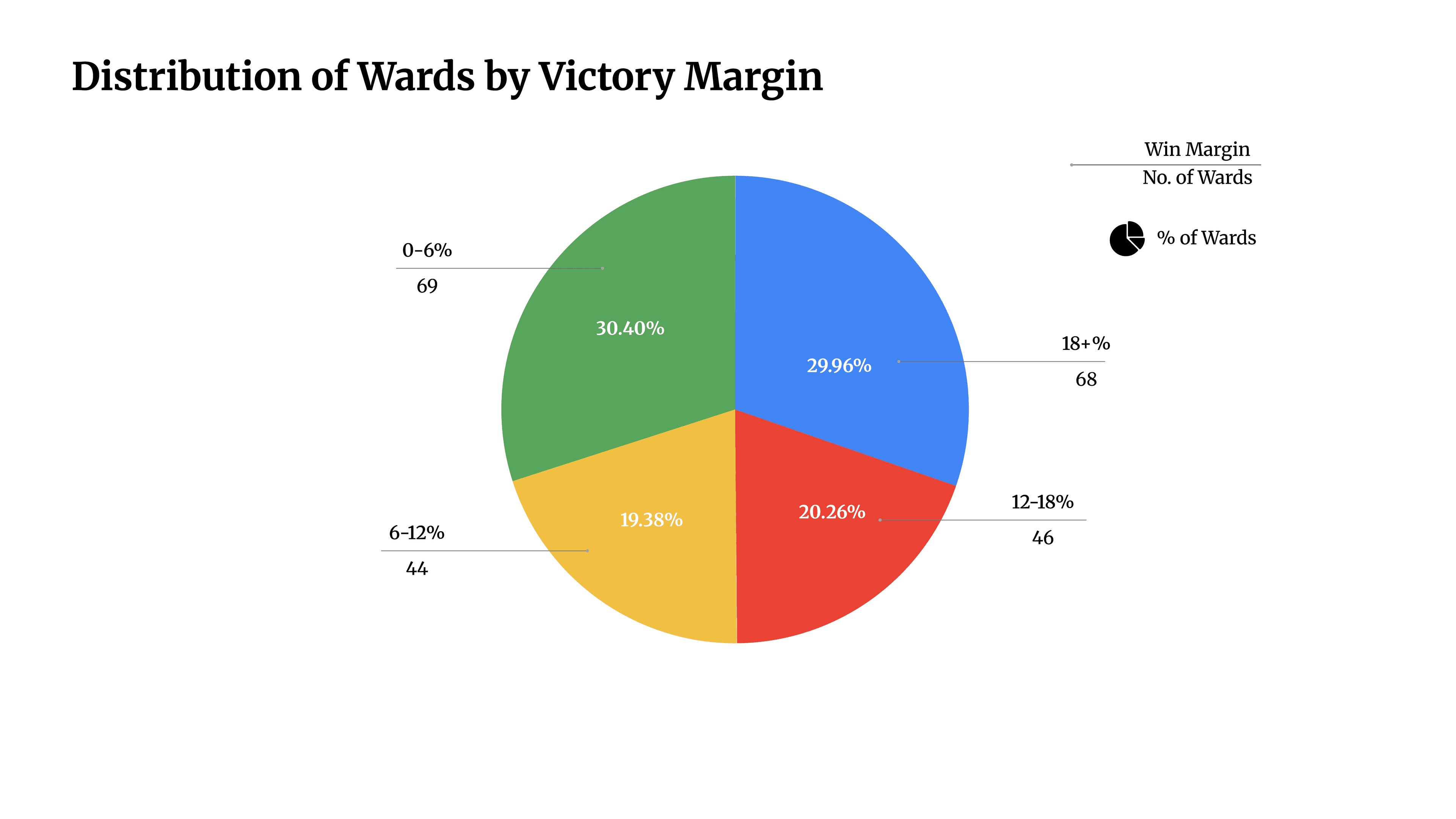
Out of the 68 wards where the win margin was more than 18%, 33 were won by BJP, 25 by Shiv Sena (united), 4 by INC and rest 6 by others.
This distribution tells us something fundamental about BMC elections. Mumbai’s municipal politics is structurally competitive, regardless of the party in power. Most wards are not loyal strongholds. They are fluid, sensitive to small changes in turnout, candidate quality, or vote division. Incumbency provides limited protection, and complacency is routinely punished.
Based on the 2017 results, it can be inferred that a meaningful part of the city remains electorally “available,” despite surface-level narratives of dominance. While this does not constitute a prediction for the upcoming election on its own, the distribution of victory margins suggests underlying competitive spaces that warrant closer observation.
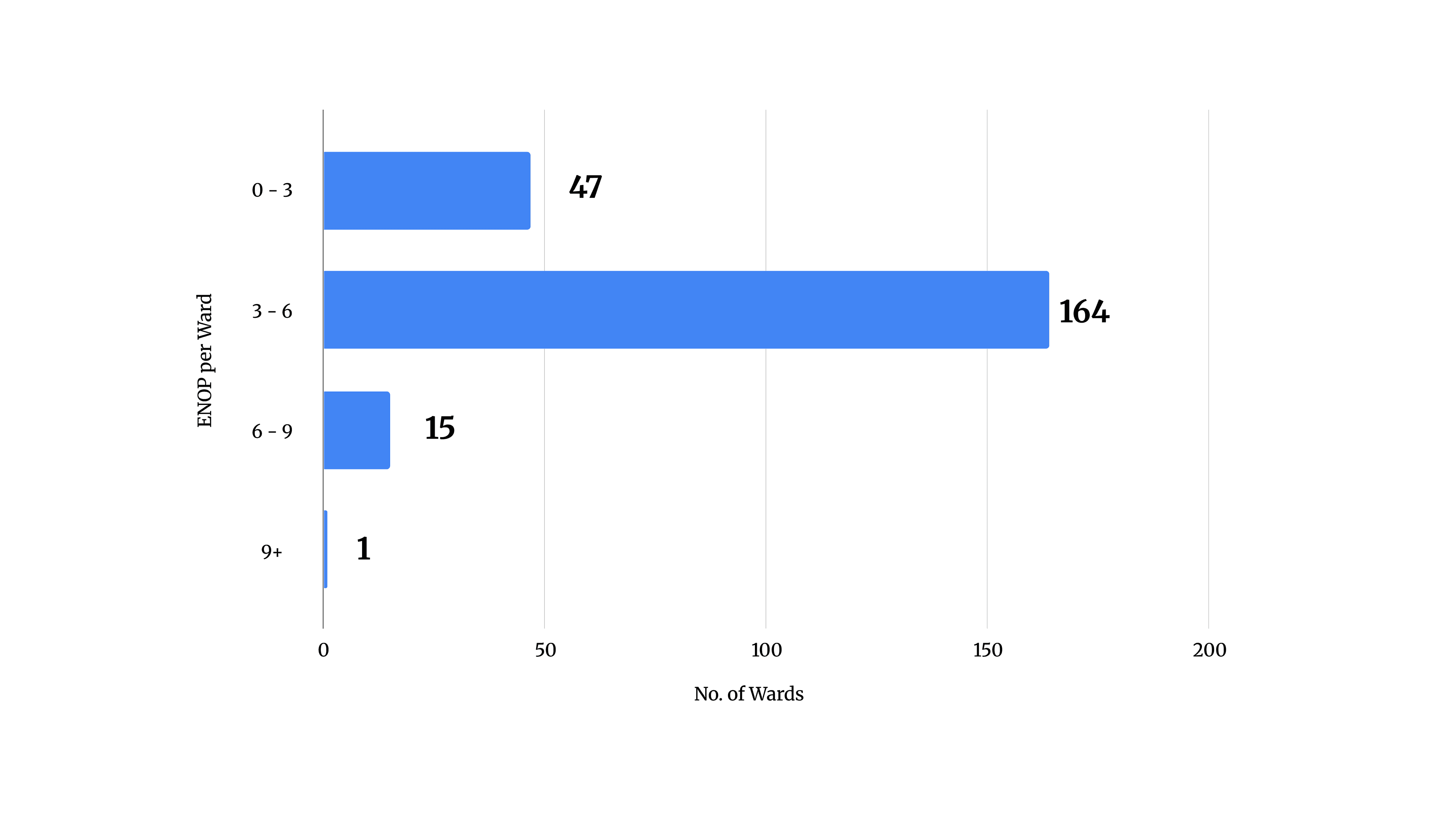
BMC elections appear crowded, but the fragmentation is systemic rather than accidental. Using the Effective Number of Parties (ENOP) makes this clearer by focusing on how many parties actually influence outcomes, not just how many are on the ballot. ENOP, a statistical measure that weights parties by their vote share and reflects the real polarity of a contest by discounting marginal players with negligible support.
The 2017 data shows that fragmentation is structural. A clear majority of wards 164 in total had an ENOP between 3 and 6, indicating genuinely multipolar contests where several parties commanded meaningful vote shares.
The table below shows the performance of various parties in various wards with different polarities. Both BJP and Shiv Sena (united) perform well in moderately crowded contests (ENOP 3-6), which is where most BMC wards fall. Though Shiv Sena (united) has higher wins in this category but BJP’s number indicates that it can compete effectively even when the contest is multipolar. INC’s pattern is even more concentrated in multipolar settings: 30 of its 31 ward victories came in ENOP 3-6 contests.
Where BJP clearly pulls ahead when the contest is two or three cornered (ENOP 0-3), winning far more seats than Shiv Sena (united). This reflects BJP’s strength in vote consolidation and organisational discipline when contests are narrow.
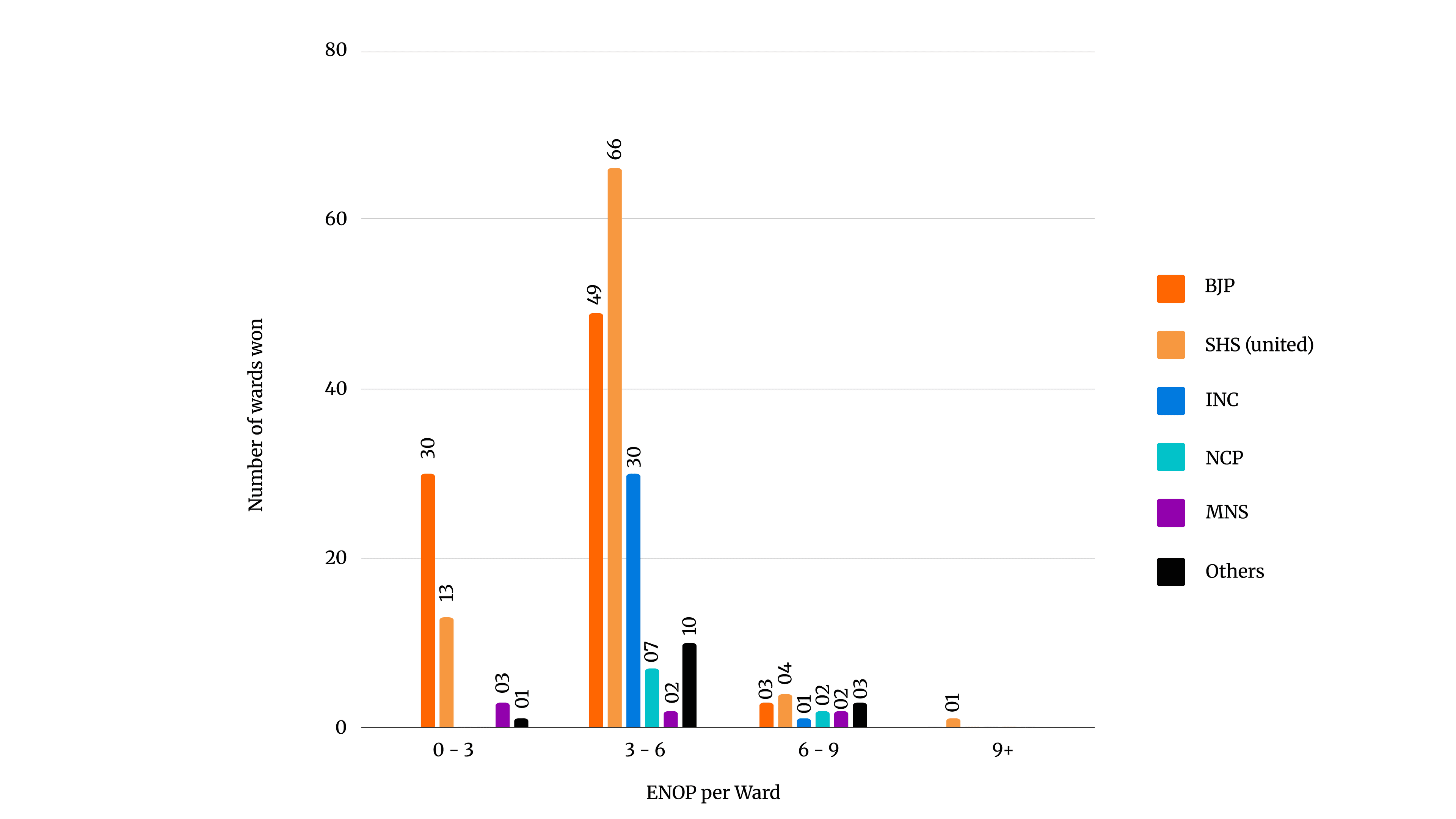
In short, fragmentation defines most BMC wards, but when contests narrow and consolidation matters, BJP performs more effectively.
Although BJP and Shiv Sena (united) ended 2017 with similar seat counts, the nature of their victories differed in important ways.
BJP’s wins tended to be deeper. A significant number of BJP wards were won with vote shares exceeding 40%, and a notable subset crossed the 50% mark. This indicates stronger vote consolidation and clearer voter alignment in those wards. Such victories are typically harder to dislodge and signal organisational depth.
Shiv Sena (united), on the other hand, won a larger number of wards with mid-range vote shares, particularly in the 35-45% band. This points to a broader but thinner dominance, strong presence across many wards, but fewer overwhelming mandates.
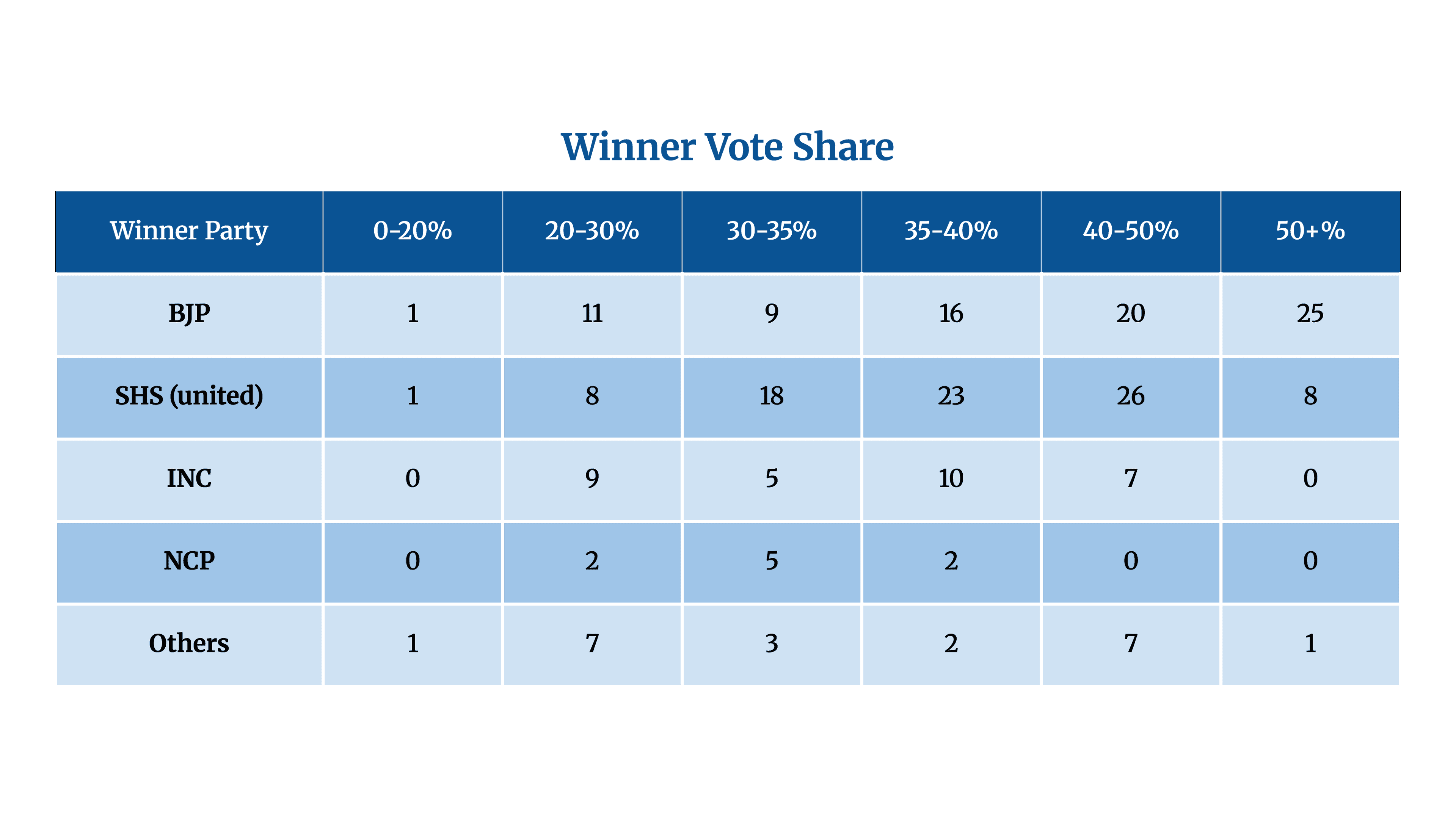
This distinction matters because depth ages better than spread. In periods of political churn or alliance realignment, parties with deeper consolidation are better positioned to absorb shocks.
While vote-share depth shows BJP’s clearer consolidation advantage, win-margin data adds an important layer of nuance. If we look at the average win margin table, BJP stands tall at the table while SHS (united) average win margin is quite lower than BJP.
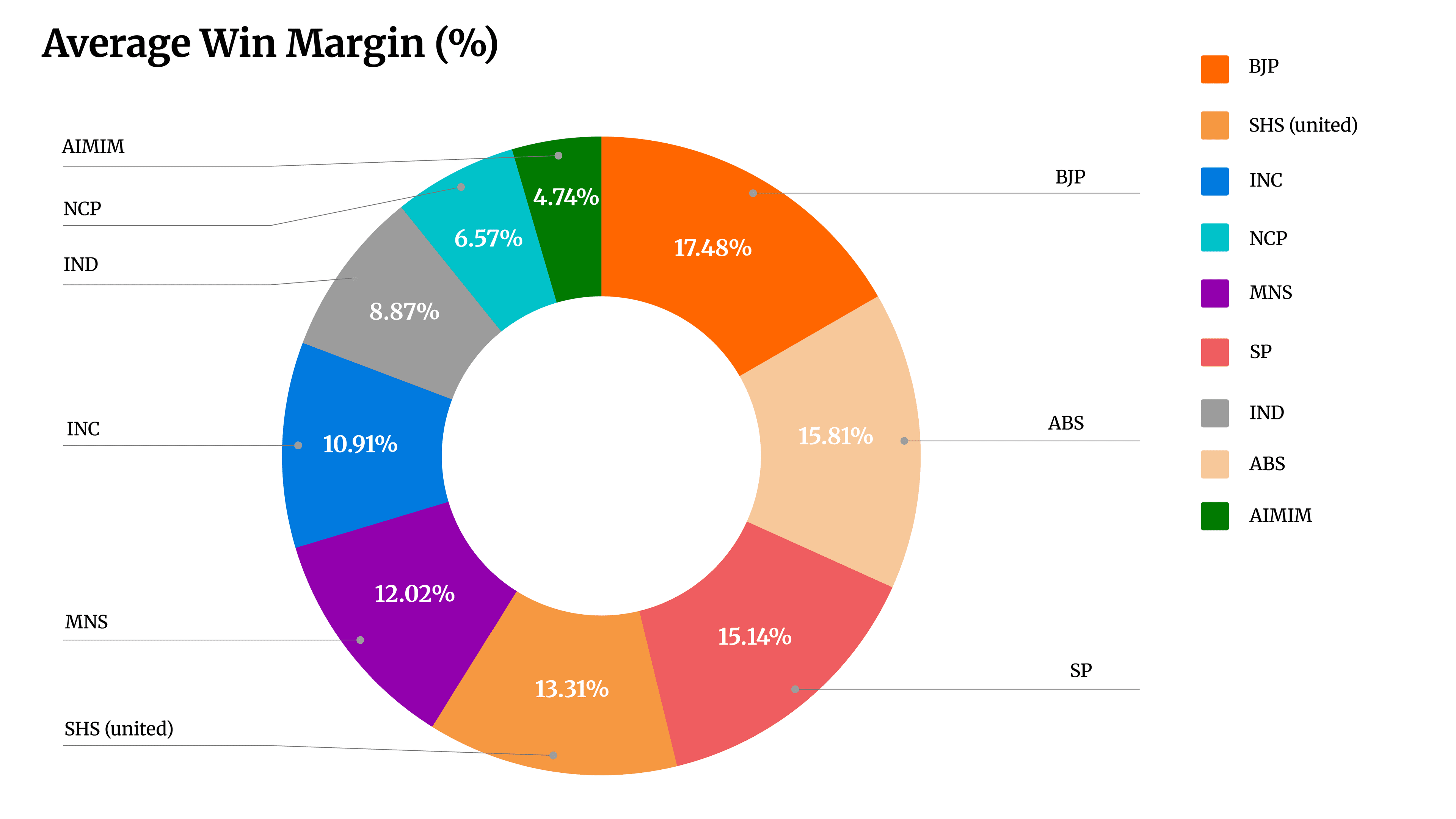
Both parties win across Mumbai, but BJP wins with a slightly larger safety cushion. The edge lies in margin, not scale.
The runner-up margin data highlights where elections were almost won. SHS (united) stands out by finishing runner-up in more wards than BJP, many by small margins, pointing to missed consolidation rather than weak presence. These seats represent low-effort, high-return opportunities.
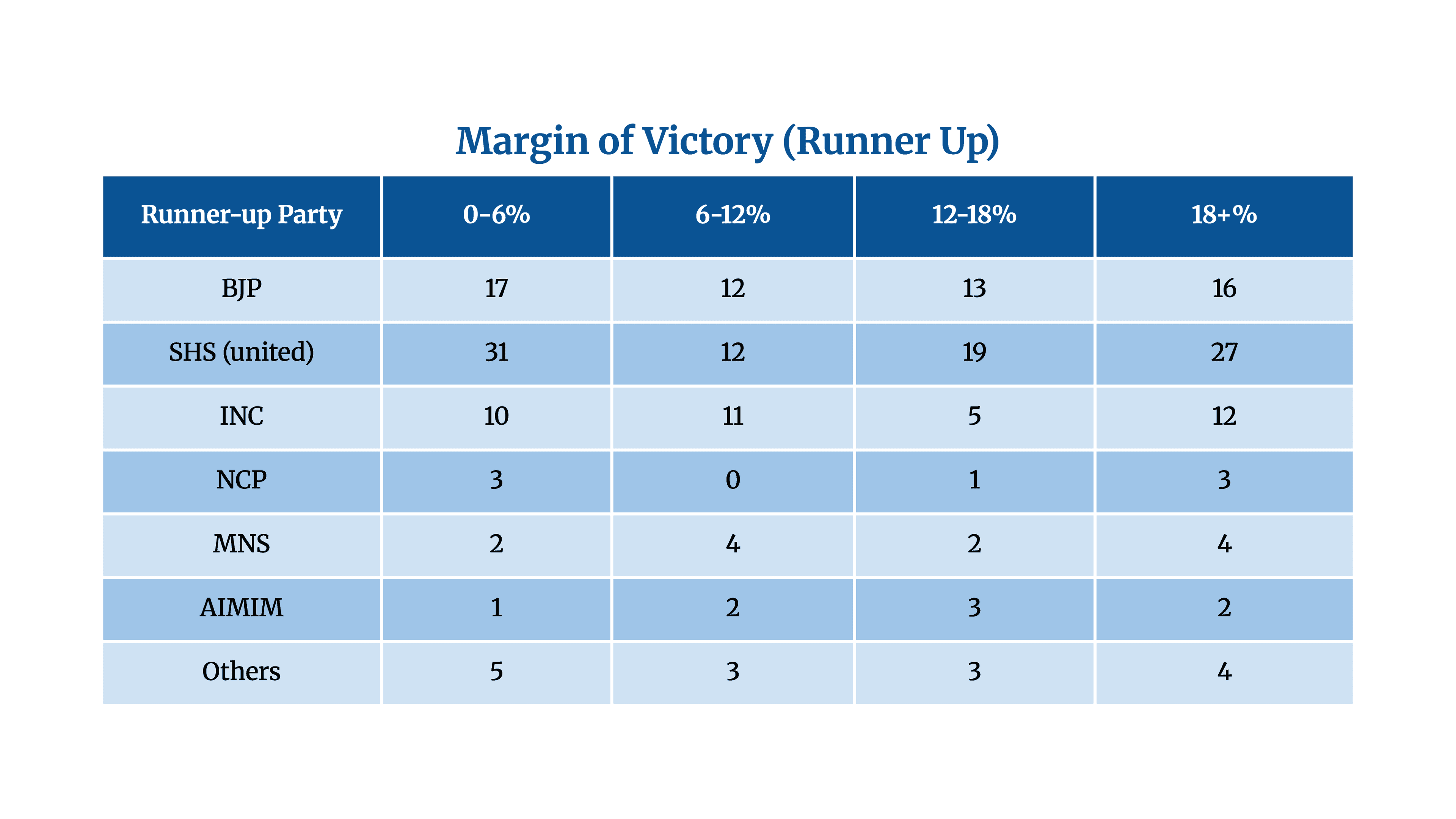
Such wards do not require ideological reinvention or dramatic swings. They require: Marginal vote swings, better candidates, or turnout shifts can flip results. This is where serious campaigns are won, not in headline-friendly landslides.
Turnout across BMC wards follows a clear but uneven pattern. In most wards, voting falls within a narrow middle range, with around 20,000-25,000 voters turning out. These wards form the electoral “normal zone”, where results are shaped by marginal mobilisation and routine campaigning rather than dramatic shifts.
The real leverage lies at the edges. In 11 wards, turnout remained as low as 10,000-15,000 voters. Here is a breakdown of the wards by the number of votes polled in each ward .
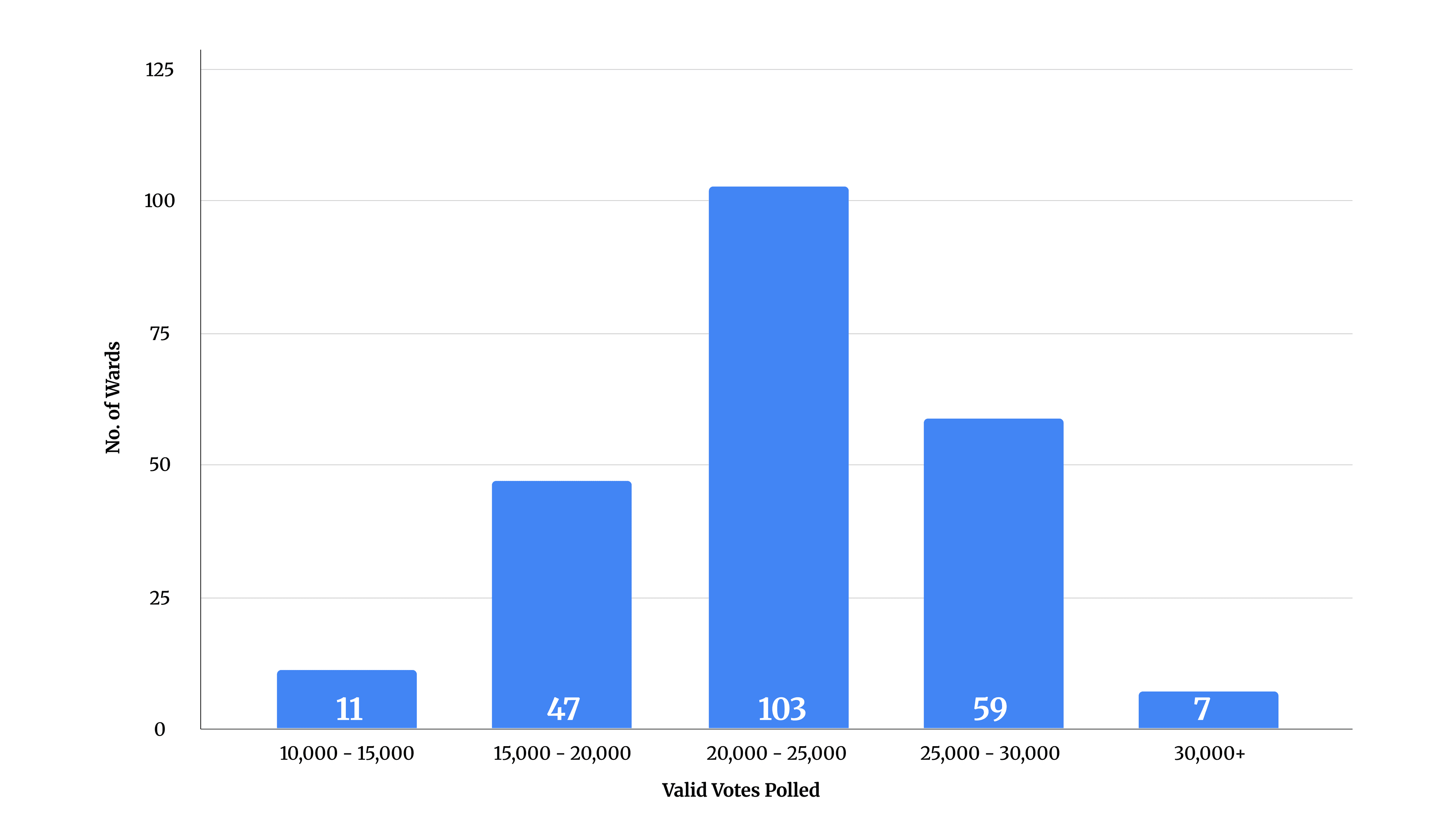
Wards with higher turnout are structurally harder to influence, as victory depends on sustained, broad-based participation rather than micro-level tactics.
Together, these patterns show that BMC elections are fought on uneven terrain, where the effort needed to win or defend a ward varies significantly. In this context, voter mobilisation becomes as important as vote share in shaping municipal power.
The 2017 BMC election shows that municipal power in Mumbai is not decided by waves or citywide mandates, but built slowly through numerous close ward-level contests. Winning often reflects narrow advantages rather than strong support, and losing does not imply political irrelevance. This is why BMC elections behave differently from Assembly or national contests: fragmentation, tight margins, and uneven turnout matter more than broad sentiment.
As Mumbai approaches the next BMC election, the lesson is clear: parties relying on momentum or past results risk misreading the city. Success depends on understanding local realities, defending fragile gains, and managing the margins that ultimately decide who governs Mumbai.