Politics
Article04/29/2026
How West Bengal Has Voted: A Historical Vote Share Analysis
“Bihar Elections: A Retrospective Musing” takes a deep dive into the state’s ever-evolving political landscape, from shifting alliances and caste equations to the rise of aspirational voters redefining governance. Tracing trends from 2010 to 2025, it reflects on how Bihar’s politics continues to balance between arithmetic and aspiration, identity and development.
Bihar. Just the name sparks a political science seminar, a melodrama, and a high-stakes poker game, all rolled into one. Let's be real, Bihar’s politics has never, ever been dull. It’s a relentless, high-octane stage where alliances flip overnight, loyalties mutate faster than the next morning's headlines, and the only ideology that truly reigns supreme is survival.
Over the past fifteen years, the state has become India’s most fascinating political laboratory, where caste, coalition, and governance experiments coexist in perpetual motion.
Since 2010, if there’s one man who has held the script's quill, it's Nitish Kumar. He’s the undisputed, most enduring protagonist. Sometimes the celebrated reformer, often the clinical pragmatist, but always the pivot.
Let's look at his journey. His Janata Dal (United) has travelled a full political circle: from a sturdy partner of the BJP-led NDA to a sworn ally of the RJD–Congress Mahagathbandhan, and then back again to the NDA. Each turn wasn’t just a twist in alliances; it reflected Bihar’s fluid political DNA, where numbers often outwit ideology.
Meanwhile, the BJP has shed its "junior partner" skin and ballooned into a powerhouse, combining central resources with a disciplined ground network that penetrates even rural pockets once dominated by caste-led politics. The RJD, anchored in the Yadav-Muslim combine, remains a force of emotional loyalty but now courts young voters who speak of jobs and opportunity more than identity.
The change isn't just on the political battlefield; it’s on the ground. Bihar itself has fundamentally changed. Roads stretch wider, homes glow brighter, and classrooms hum louder. Migration continues, but so does aspiration. This is not the Bihar of 2005, trapped in stereotypes and jungle raj. Today’s voter is sharper, demanding both dignity and delivery.
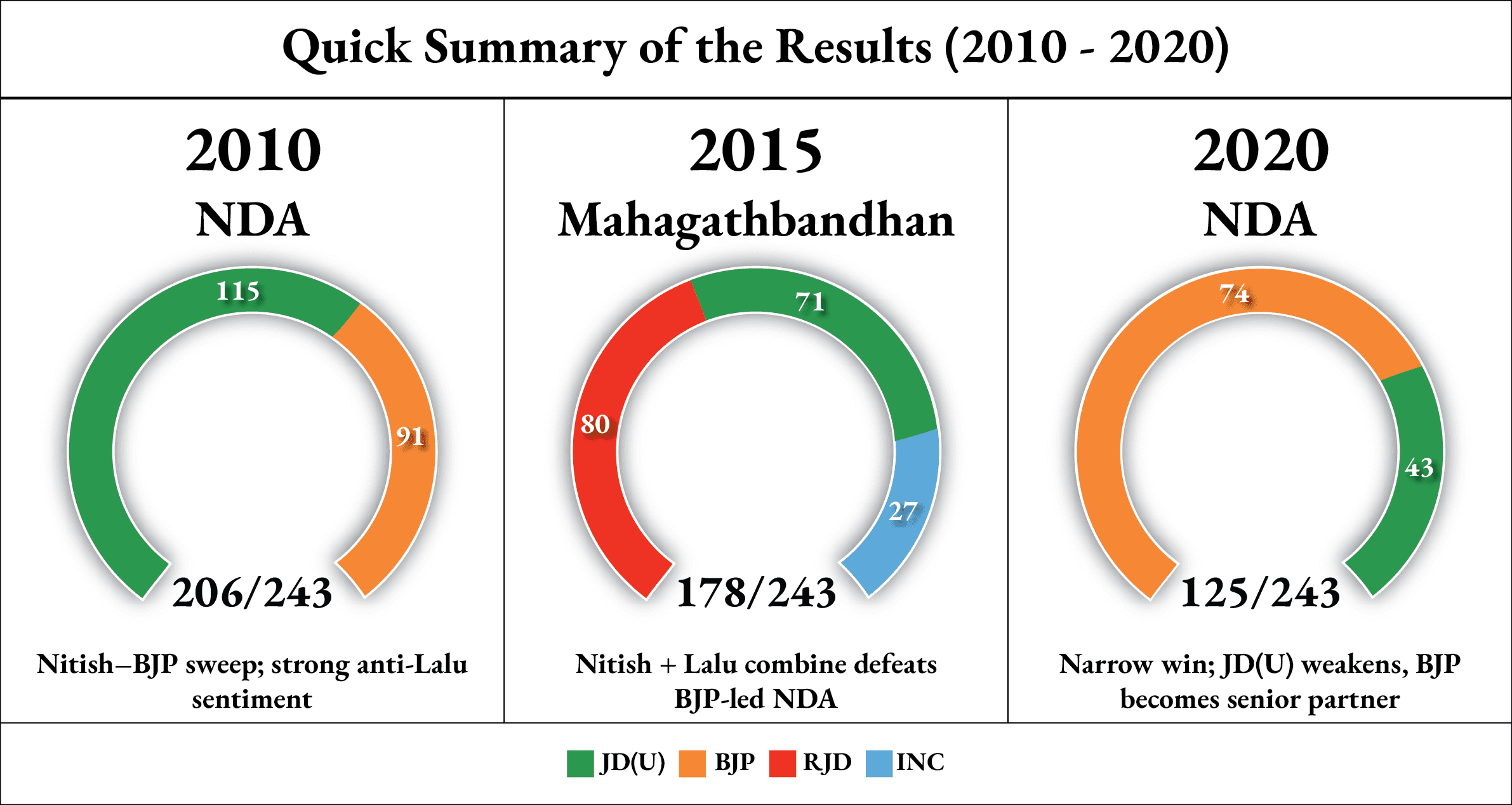
Below, we dive deep into how the fight unfolded in 2015 and 2020. Both were very different yet equally complex elections.
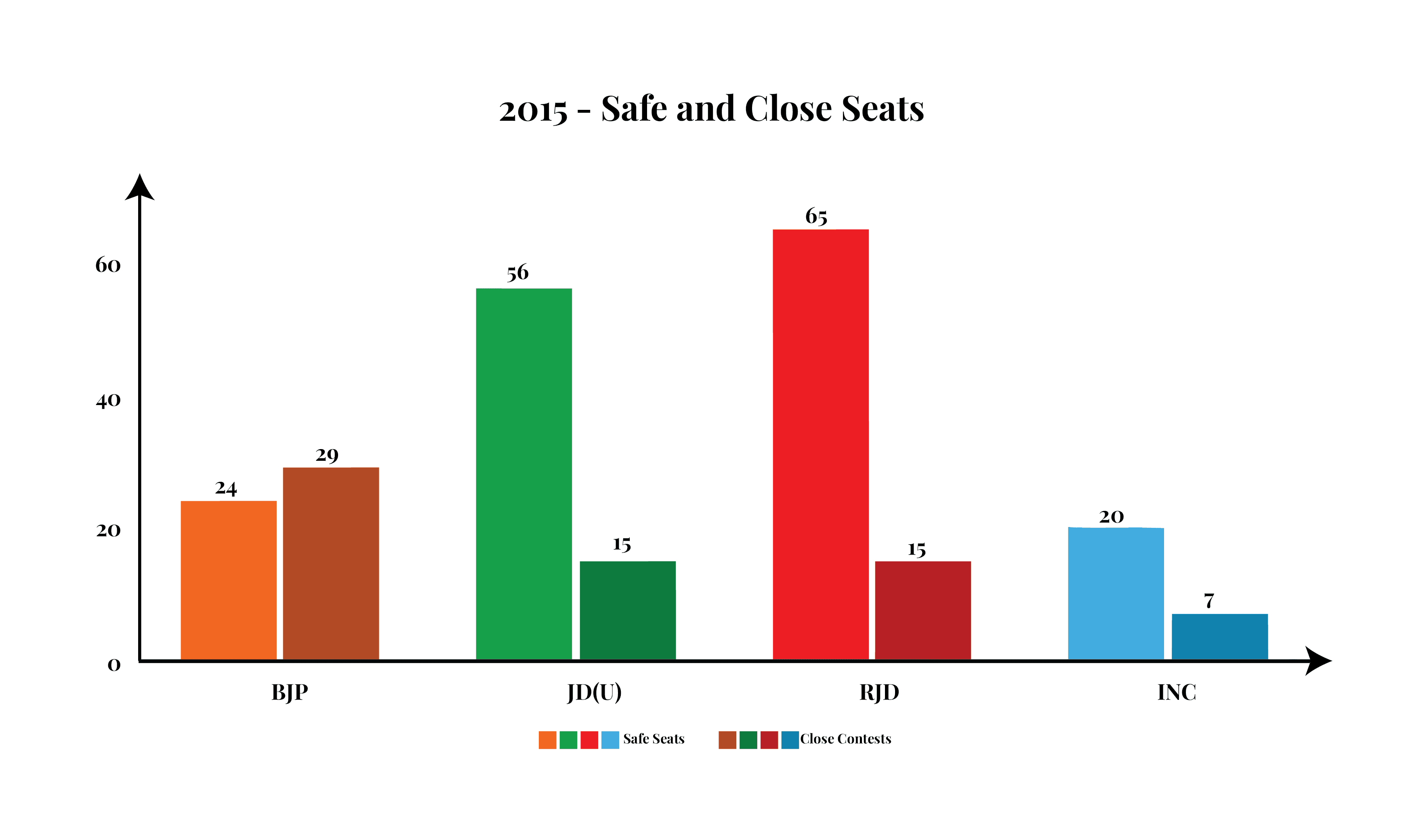
The 2015 Bihar Assembly elections stood out for their decisive nature, with far fewer marginal seats and nearly two-thirds of constituencies won with comfortable margins. What particularly caught observers’ and analysts’ attention, however, was the resurgence of the Rashtriya Janata Dal (RJD). Despite being out of power for nearly a decade, the RJD’s strong grassroots network proved resilient.
Teamed with Nitish Kumar’s Janata Dal (United) and bolstered by his clean governance image and well-calculated caste arithmetic, the alliance presented an almost unbeatable front. In sharp contrast, the Bharatiya Janata Party (BJP), while riding the high of the national "Modi wave," was still grappling with consolidating its own independent voter base across Bihar’s complex social matrix. The outcome reflected this reality, with results showing an almost 50-50 split between safe and closely contested seats, highlighting the state’s complex political dynamics.
Ultimately, 2015 underscored one clear lesson for every political party in Bihar: no coalition could afford to ignore Nitish Kumar’s influence. The BJP, despite its national momentum, struggled to overcome the combined strength of the RJD-JD(U) juggernaut.
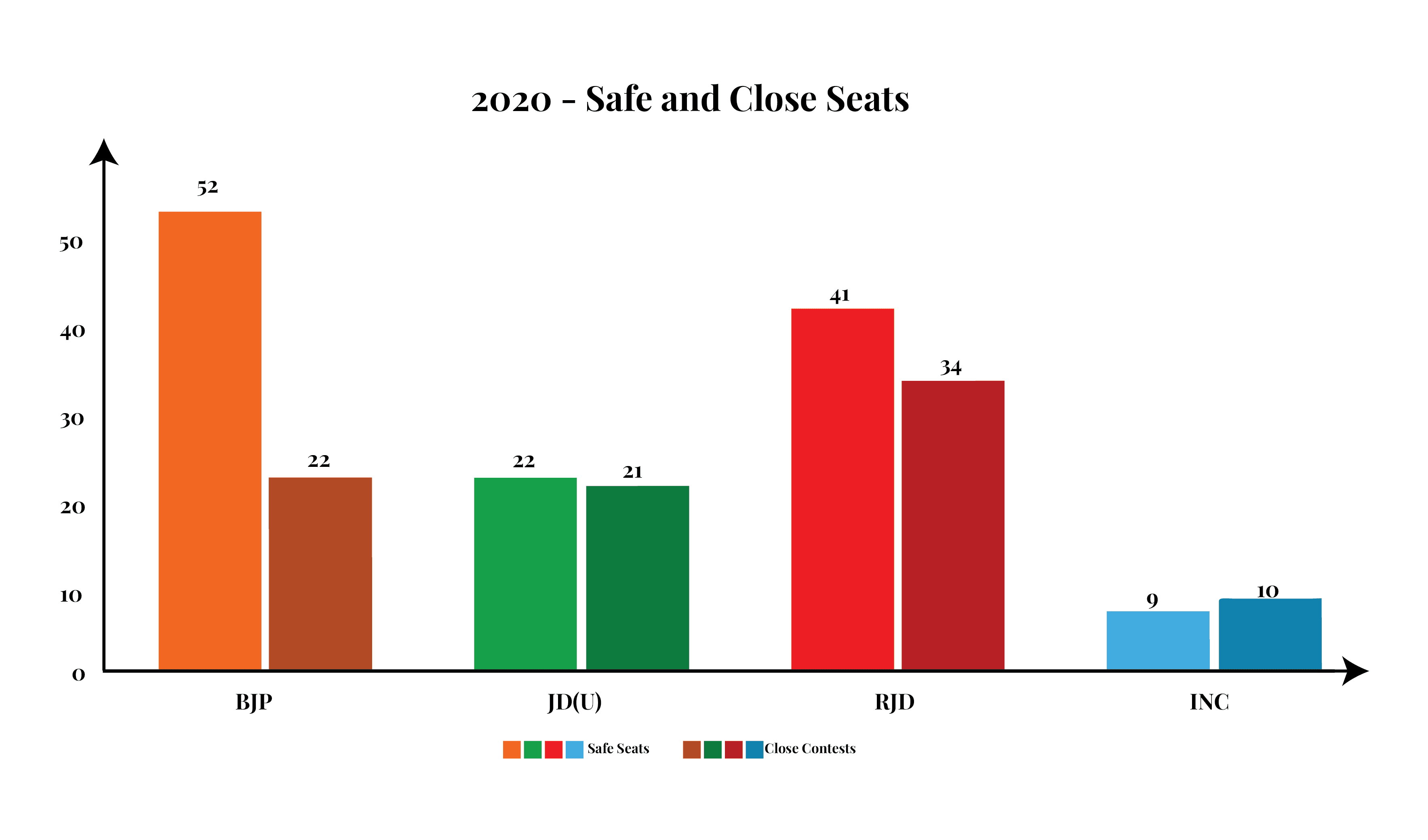
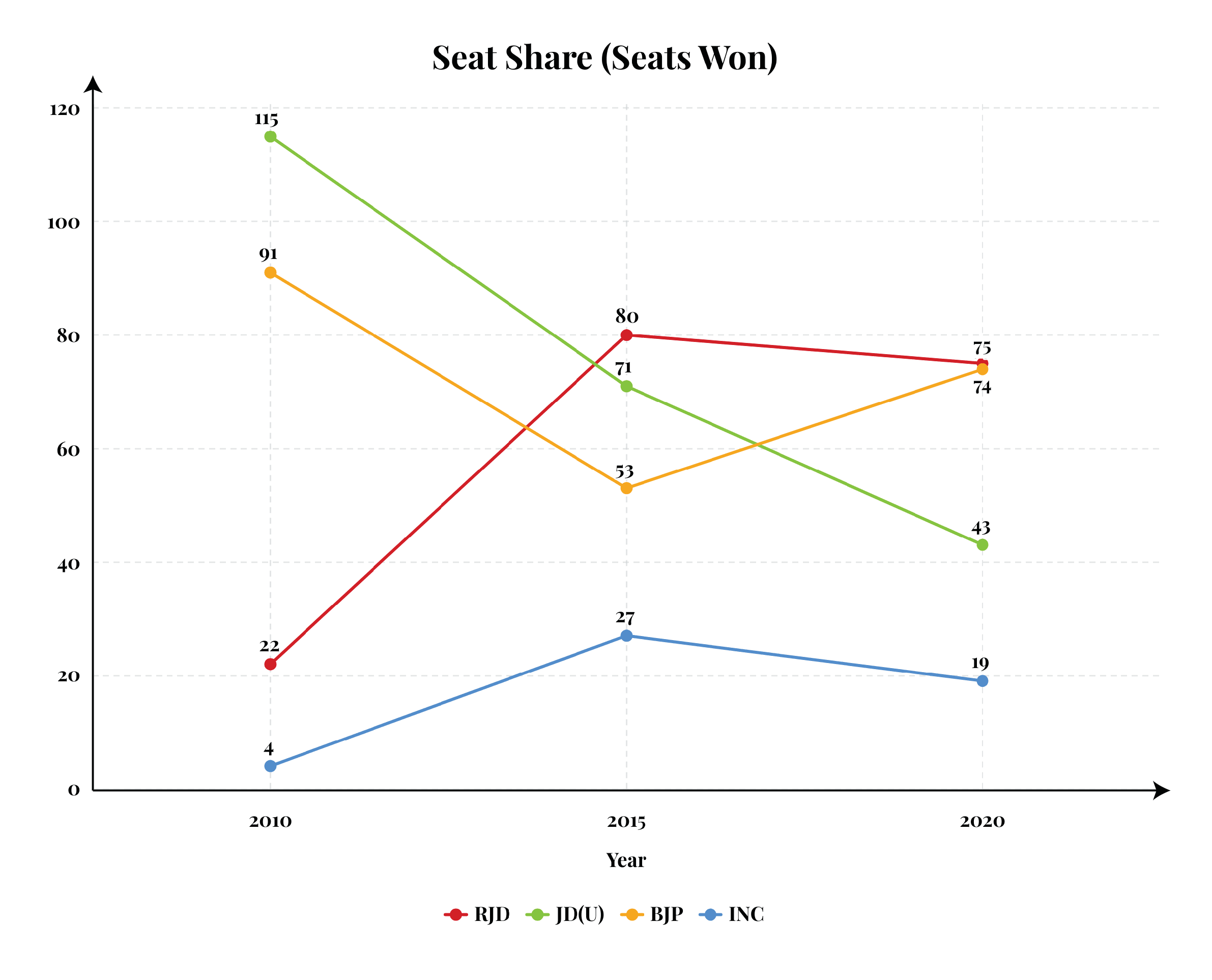
One surprising and interesting observation that became apparent on the counting day in 2020 was that the BJP, which seemed incapable in 2015 to pull votes and win elections, had emerged as the “Big Brother” by 2020. These results not only reflected the changing mindset of the Bihar electorate but also pointed towards a rising “aspirational” class of voters, who looked at the BJP not just as an alternative to RJD, but perhaps also to the JDU. Both RJD and JDU in this election struggled to grab hold of safe victories. RJD’s average victory margin, in spite of being the single largest party, stood at 9% compared to 12% of the BJP.
In the case of the JDU, the JDU also struggled to repeat their previous performances, this was in part due to voter fatigue and the rising strength of the MY combination of the RJD. This left JDU with just 43 wins, and admittedly, one of their poorest showing. However, JDU was also held back by the independently contesting LJP, which mainly fought on those seats where the contest was RJD vs JDU, thus directly hurting JDU’s chances on those seats.
Ultimately, 2020 became a powerful statement: the BJP had maximised its potential and secured its spot at the top of the state’s political pyramid, redefining the power dynamic in Bihar’s always-fluid coalition politics.
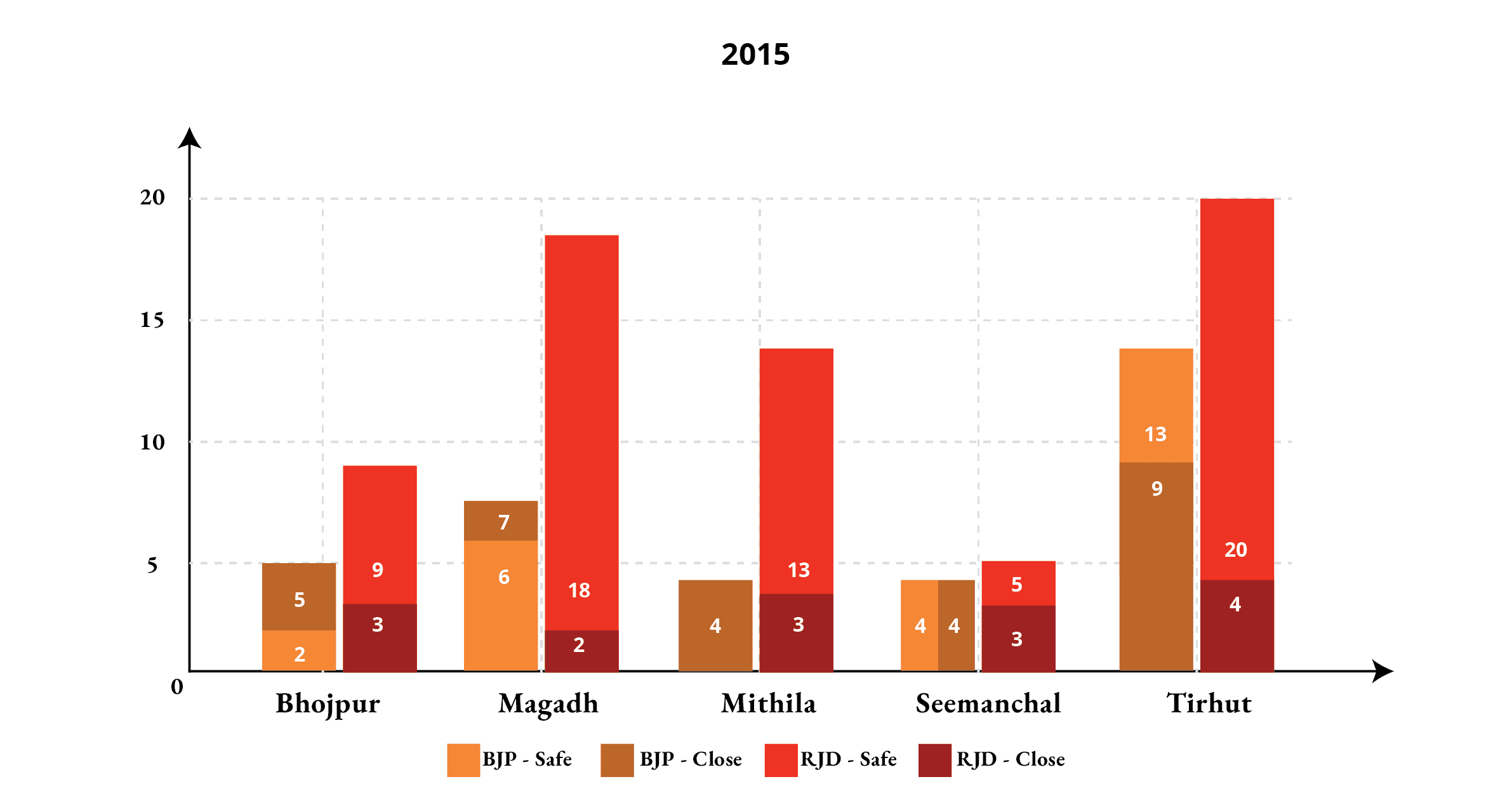
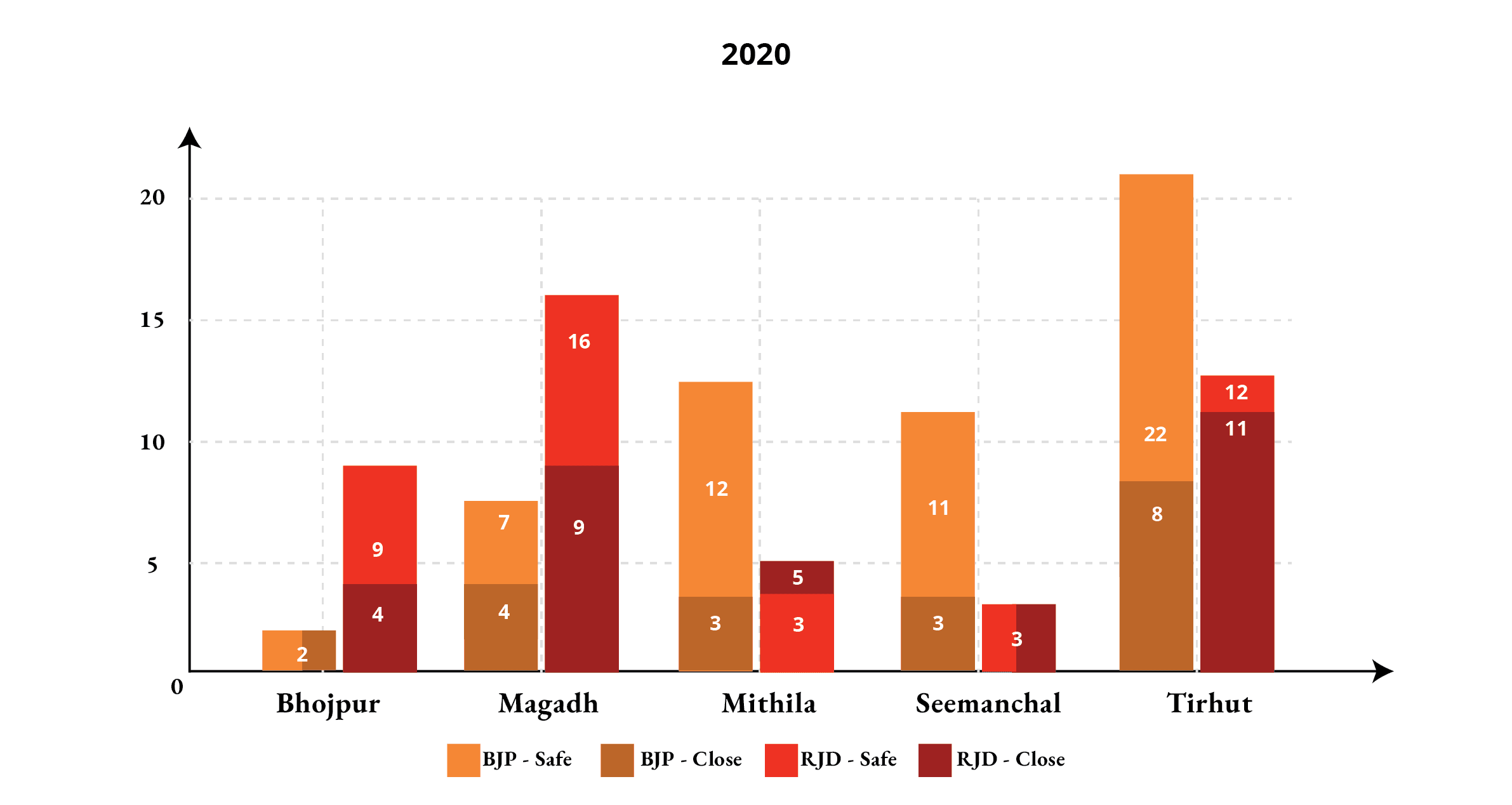
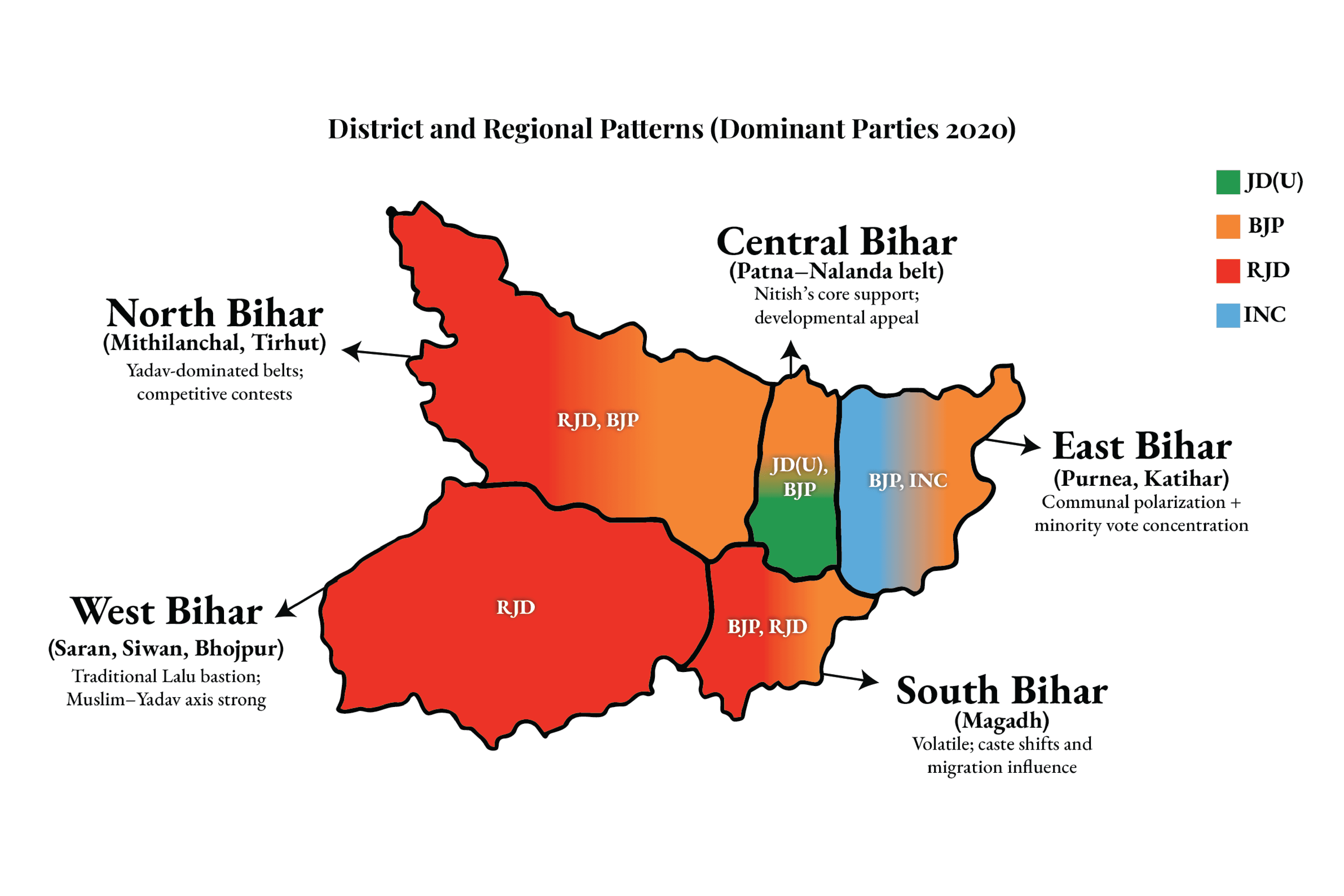
BJP’s increasing strength across Mithila and Seemanchal regions is undeniable, and what is fascinating is that it has come at the expense of RJD. RJD’s footprint has significantly reduced in both these regions. AIMIM’s surge in Seemanchal effectively made 2020 a tri-cornered fight, and the BJP was the biggest beneficiary of such fights. In areas like Purnia, Araria, which are traditionally known to be polarised, the BJP’s surge has given the RJD a tough opponent in these regions.
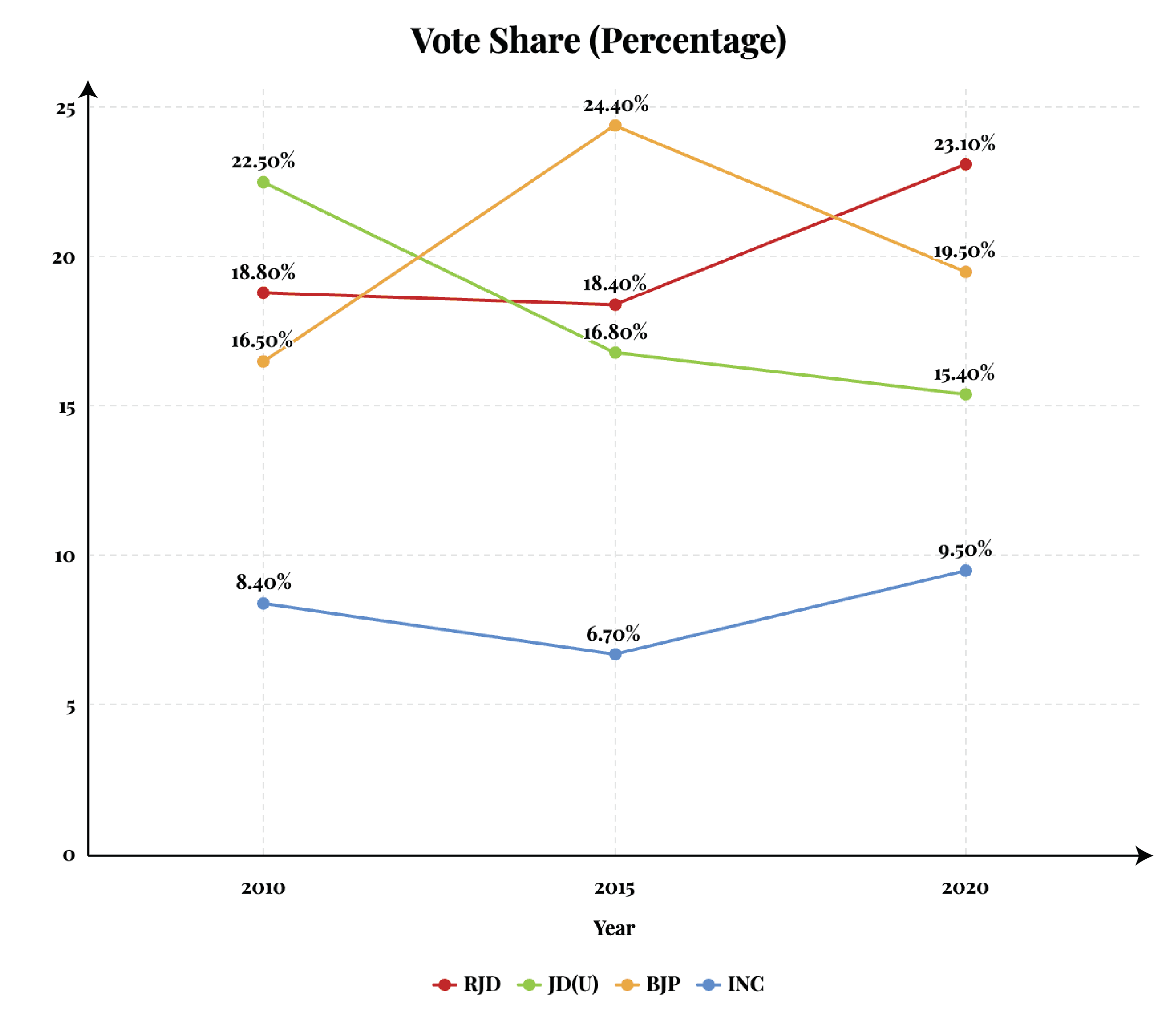
BJP’s best performance had come in the 2010 elections, where they had secured 91 seats. This was largely seen as a referendum not just on the alliance with Nitish Kumar’s JDU, which won 115 seats, but also on the overall law and order improvement largely credited to Nitish Kumar during his earlier tenure in 2005. The baggage of jungle-raj seemed to get lighter over the years as the BJP slowly started to establish its own strength in the state with a dedicated voter base, especially post 2014 and into the Modi-Era.
Then came the 2015 election,the biggest political shock of the decade. Riding a powerful national Modi Wave, political commentators and analysts alike were certain the BJP would secure a massive showing in Bihar. What 2015 proved, perhaps for the last time in a major state election, was that in Bihar, the deep-seated caste arithmetic of the Mahagathbandhan had the power to outmatch both the BJP’s superior organisational strength and the emerging aspirational politics. It was a defiant, final stand of identity politics against the national tide, but one that ultimately proved to be an anomaly in the longer-term trend .
Bihar's political history since 2010 can be perfectly decoded by viewing it through three critical lenses: voter composition, alliance fluidity, and issue transformation. This trio dictates whether the state swings toward identity or aspiration
In 2010, development and “Sushasan Babu” (good governance) were dominant themes; Nitish Kumar’s alliance with the BJP projected stability and reform. By 2015, the political script flipped, and the Grand Alliance leveraged caste solidarity and anti-incumbency. In 2020, the NDA held on but barely, showing fatigue within the JD(U) ranks and strong anti-incumbency tempered by the BJP’s grassroots organization and central welfare appeal. In 2020, the trajectory of the JDU witnessed a downward slide, this signaled fatigue and possibly even boredom amongst voters who were split between choosing an ageing Nitish Kumar and a promising, young but tainted with Jungle Raj themes, Tejashwi Yadav .
Backdated Studies and the 2022 Caste Census
Few events have redefined Bihar’s electoral imagination like the 2022 Caste-Based Survey. Conducted under Nitish Kumar’s government, it officially quantified social hierarchies: OBCs (including EBCs) constitute roughly 63%, Scheduled Castes 19.65%, Scheduled Tribes 1.68%, and Upper Castes about 15.5% of the population. These figures reaffirm Bihar’s identity as an OBC-dominant polity and have triggered recalibration across alliances.
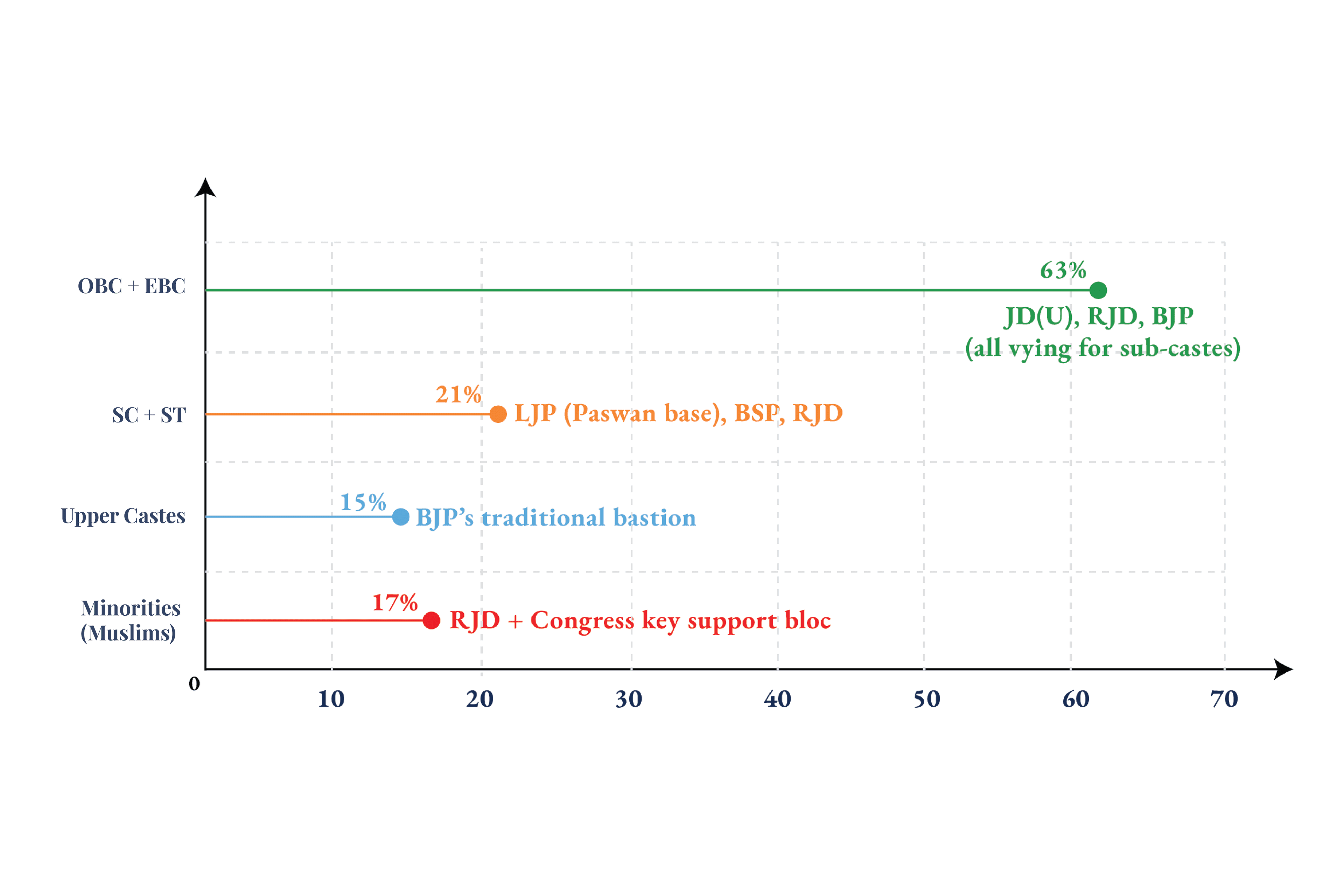
The caste census data has reenergized EBC politics, pushing JD(U) and RJD to promise proportional representation in tickets and schemes. For the BJP, which has leaned heavily on non-Yadav OBCs, this creates both opportunities and tensions. Every party is tailoring welfare rhetoric like jobs, education, and housing around caste data visibility. The immediate impact of the caste census was a wave of dissatisfaction amongst larger OBC groups, such as Yadav’s, who believed they were under-represented purposefully to reduce their bargaining power in electoral politics.
The 2025 Bihar Assembly Election is to be held in two phases on November 6 and 11 (counting on November 14), and it is extremely likely to test every alliance’s resilience. The state’s politics now rests on three balancing acts: identity vs. development, alliance vs. autonomy, and State vs. Centre narratives, under the larger umbrella of caste dynamics.
The Bihar of 2025 is not the Bihar of 2010. The state’s political vocabulary has expanded from “Jaati” (caste) to “Vikas” (development), and now towards “Niti” (policy-based expectation). Yet, caste remains the silent grammar of power. Today, it’s articulated not through raw, overt identity appeals, but through strategic channels: welfare entitlement, representation quotas, and subtle emotional signaling.. Narendra Modi’s appeal and call of “Vikaas bhi, Virasat bhi” seems to also resonate with a large section of the new aspirational class of voters who are attached to identity and yearn for development.
If Nitish Kumar’s career encapsulates adaptability, Bihar’s democracy reflects resilience, constantly renegotiating between structure and change. The coming election may not just decide who governs Patna, but also whether Bihar can transcend the binaries that have long defined its politics. The 2025 Assembly polls promise to be less about victory margins and more about what they reveal of Bihar’s shifting identity, maturing voter consciousness, and the enduring question of whether governance can outgrow caste. In a dynamic appeal-based election such as 2025, voter choice is expected to be based not just on scheme delivery but whether fatigue and issues are belittled and humbled by the promise of development.