Politics
Article04/29/2026
How West Bengal Has Voted: A Historical Vote Share Analysis

The Brihanmumbai Municipal Corporation election of 2026 will take place after a long gap since 2017, with no intervening municipal contests to indicate recent voting behaviour. As a result, understanding Mumbai’s next BMC election requires a focus on the structural logic of ward-level politics rather than drawing conclusions from state or national elections.
This report presents a region-wise political reading of Mumbai, using ward-level outcomes and on-ground political realities to explain how power is contested across the city. By examining demographics, leadership patterns, alliance behaviour, and organisational strength, it highlights why different parts of Mumbai behave differently within the same election. The objective is not prediction but to offer a clearer framework for understanding how BMC elections function and what that implies as the city moves toward its next municipal contest.
Mumbai North remains the most structurally favourable region for the BJP, built on a durable coalition of Gujarati, North Indian, and urban middle-class voters. It has a total of 42 wards across six Assembly Constituencies (ACs). Piyush Goyal (BJP) is the Member of Parliament from this Parliamentary Constituency (PC), and the NDA alliance holds five of the six MLAs.
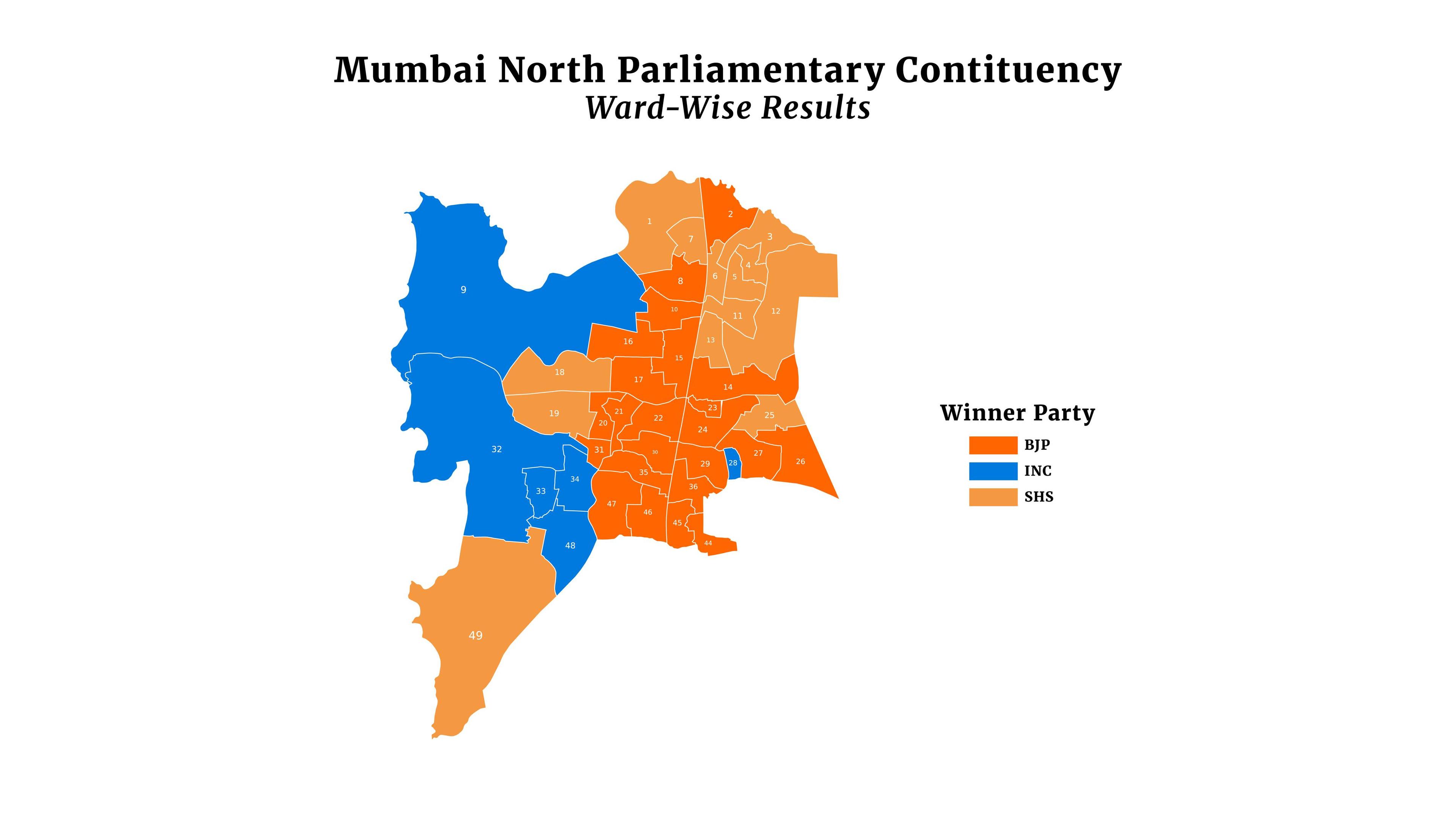
The northernmost ACs such as Borivali, Kandivali East, Dahisar, and even Charkop form the BJP’s most stable base. High urbanisation, strong RWAs, minimal minority concentration, and deep community consolidation mean that outcomes here are largely insulated from alliance shocks. Malad West’s demographic mix is very different. Significant minority pockets create genuine competition in several wards, while the BJP retains an advantage in more urban areas. This AC remains one of the more fluid spaces within Mumbai North. Magathane represents the clearest case of post-2017 political realignment. Once an SSUBT-dominated assembly, the steady migration of local leaders to the BJP and the SHS has collapsed the earlier organisational base. Ground control, rather than ideology, is decisive here, making Magathane a near-sweep zone for the BJP-SHS alliance.
Mumbai North is no longer electorally competitive in the classical sense. The contest is confined to which opposition party survives in minority pockets, not to whether BJP’s overall dominance can be challenged. The wards are expected to split roughly 80-20 in favour of the NDA.
Mumbai North West combines strong BJP and SHS leadership with persistent minority pockets, making it competitive but tilted. It has a total of 39 wards across six Assembly Constituencies (ACs). In the 2024 Lok Sabha election, the SSUBT was locked in a tough contest with the SHS’s Ravindra Waikar, a former Jogeshwari East MLA, who won by a slender margin. Both the NDA and the INDI alliance hold three MLAs each from this PC.
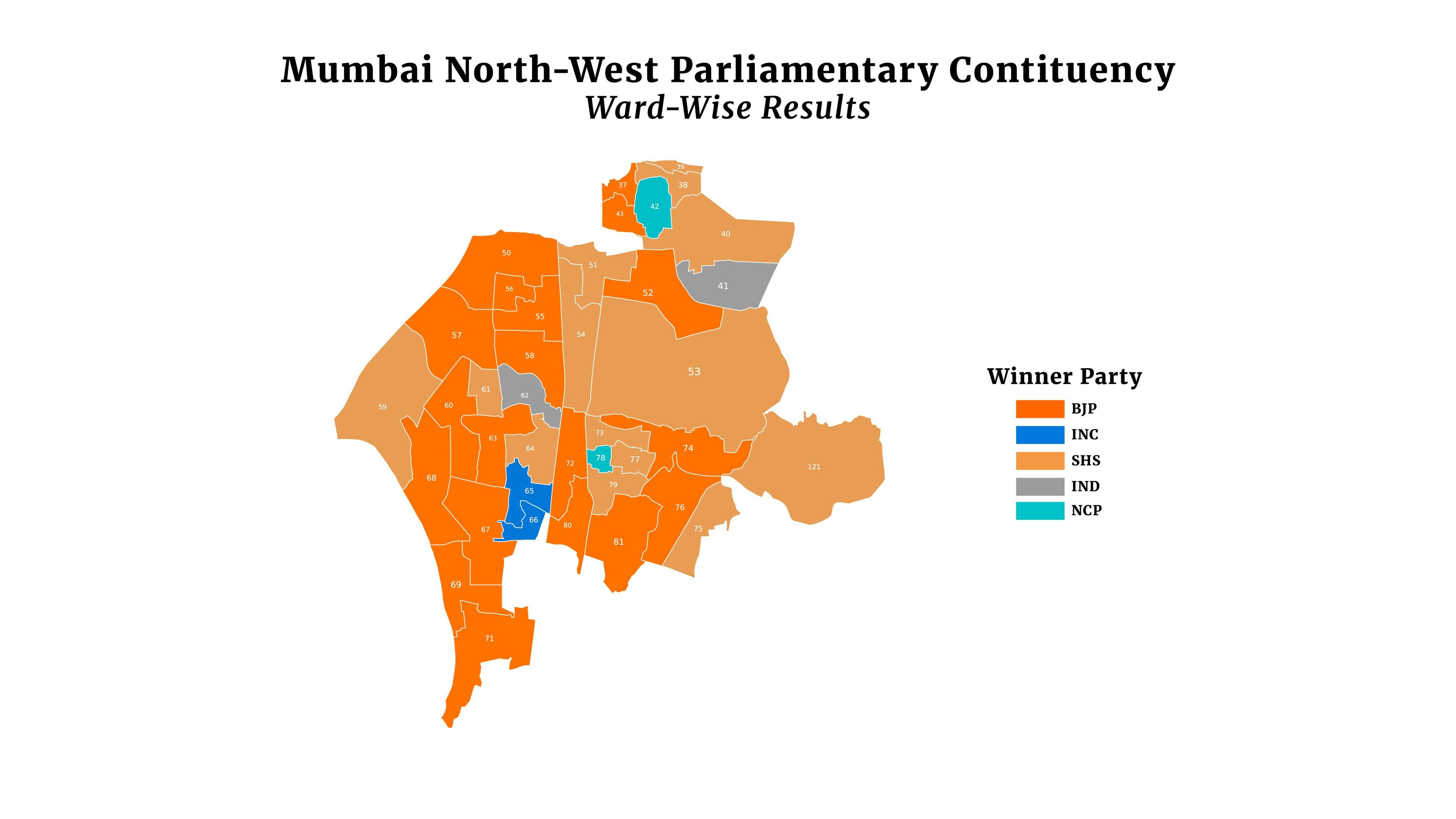
Jogeshwari East and Dindoshi have lower-income electorates where the SSUBT and the MNS have a strong ground presence, limiting the NDA’s reach. While high-rise societies favour the BJP, the larger lower-income Marathi base and a fragmented UP-Bihar vote prevent consolidation, keeping these assemblies competitive. In Andheri East and West, the BJP-SHS hold a clear advantage across most wards, helped by strong MLA-level leadership and visible groundwork. In Goregaon, leadership plays a decisive role: BJP MLA Vidya Jaiprakash Thakur’s ground-level work significantly strengthens the party’s position. The BJP is well placed to win most wards, though one ward in eastern Goregaon remains competitive for the SSUBT. Versova is sharply split between urban BJP voters and neighbourhoods with a substantial minority population and a working-class Marathi base aligned largely with the SSUBT, keeping contests finely balanced.
Mumbai North West favours BJP-SHS, but minority and traditional marathi pockets ensure that outcomes are not entirely locked. Tactical errors can still cost a few wards. The wards are expected to be split 55-45 in favour of the NDA.
This region splits cleanly between BJP-dominant Gujarati belts and working-class Marathi voters, along with pocketed minority zones. It has a total of 39 wards across six Assembly Constituencies (ACs). Sanjay Dina Patil of the SSUBT is the Member of Parliament from this Parliamentary Constituency (PC), with the six ACs split equally between the NDA and various INDI alliance parties.
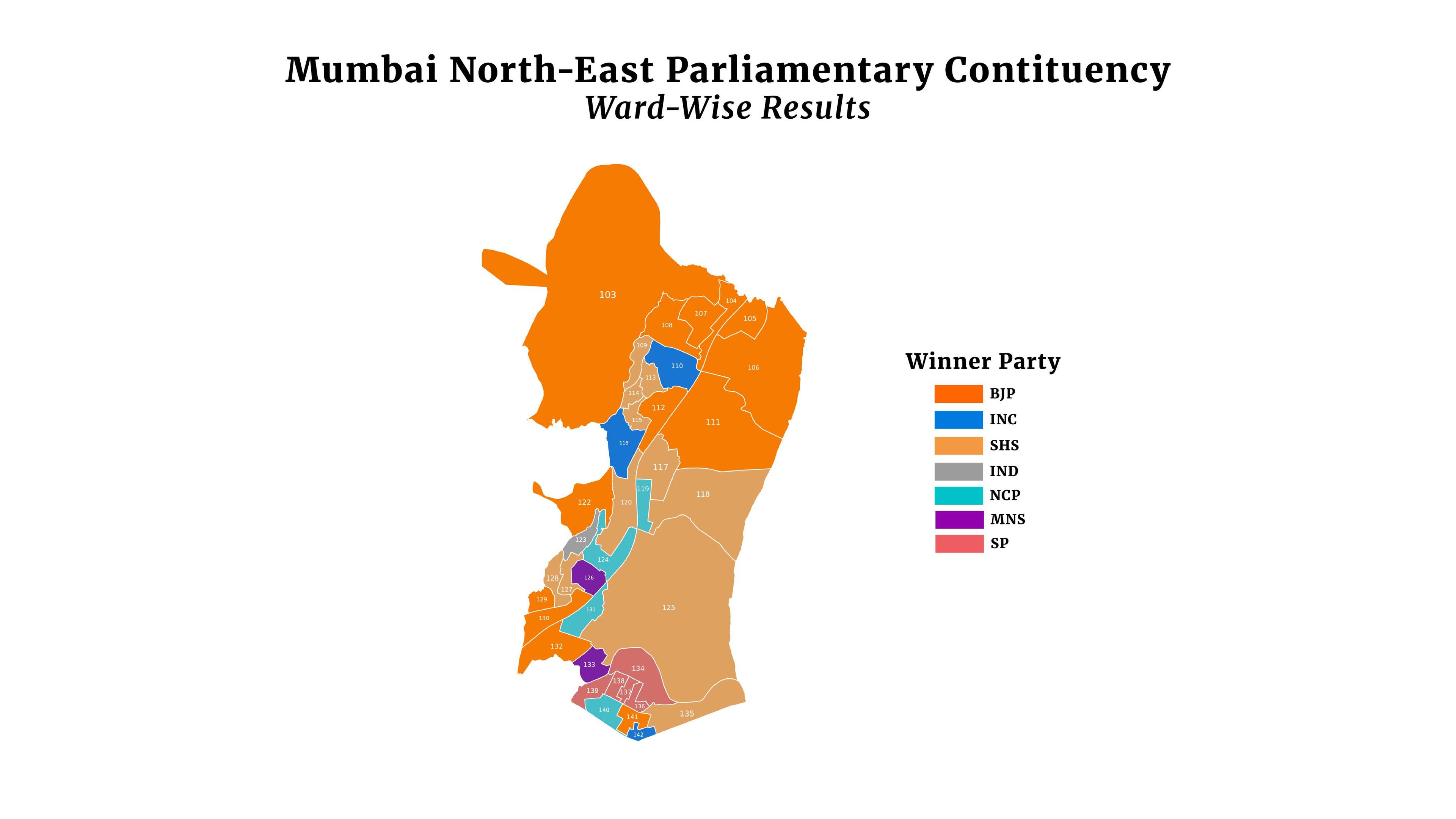
In ACs such as Mulund and Ghatkopar (East and West), Gujarati voter consolidation in favour of the BJP remains the party’s principal strength. All three MLAs are from the BJP and are reasonably popular, and tight booth management combined with leadership continuity makes outcomes in these ACs largely predictable. In Bhandup West and Vikhroli, the electorate leans towards the SSUBT-MNS, driven by lower-income Marathi voters and minority pockets. However, the BJP-SHS can mount a credible challenge in Bhandup West due to local organisational strength. Mankhurd-Shivaji Nagar is a Muslim-majority assembly where the INC, SP, and AIMIM define the electoral contest. The BJP’s relevance is entirely contingent on minority vote fragmentation; otherwise, its electoral ceiling remains low.
Mumbai North East is not a BJP-SHS sweep zone, but a two-speed region impregnable in Gujarati belts, structurally resistant elsewhere. The ward wise split is roughly the same as North-West with 55-45 in favour of the NDA.
Mumbai North Central remains the most politically complex and analytically rich region of the city. Almost every assembly here is shaped by vote fragmentation rather than clear dominance. It has a total of 40 wards across six Assembly Constituencies (ACs). This Parliamentary Constituency (PC) has the highest concentration of non-Hindu Scheduled Caste voters, who have traditionally supported the INC. In the 2024 Lok Sabha election, Varsha Gaikwad (INC) won from here, defeating the BJP candidate Ujjwal Nikam.
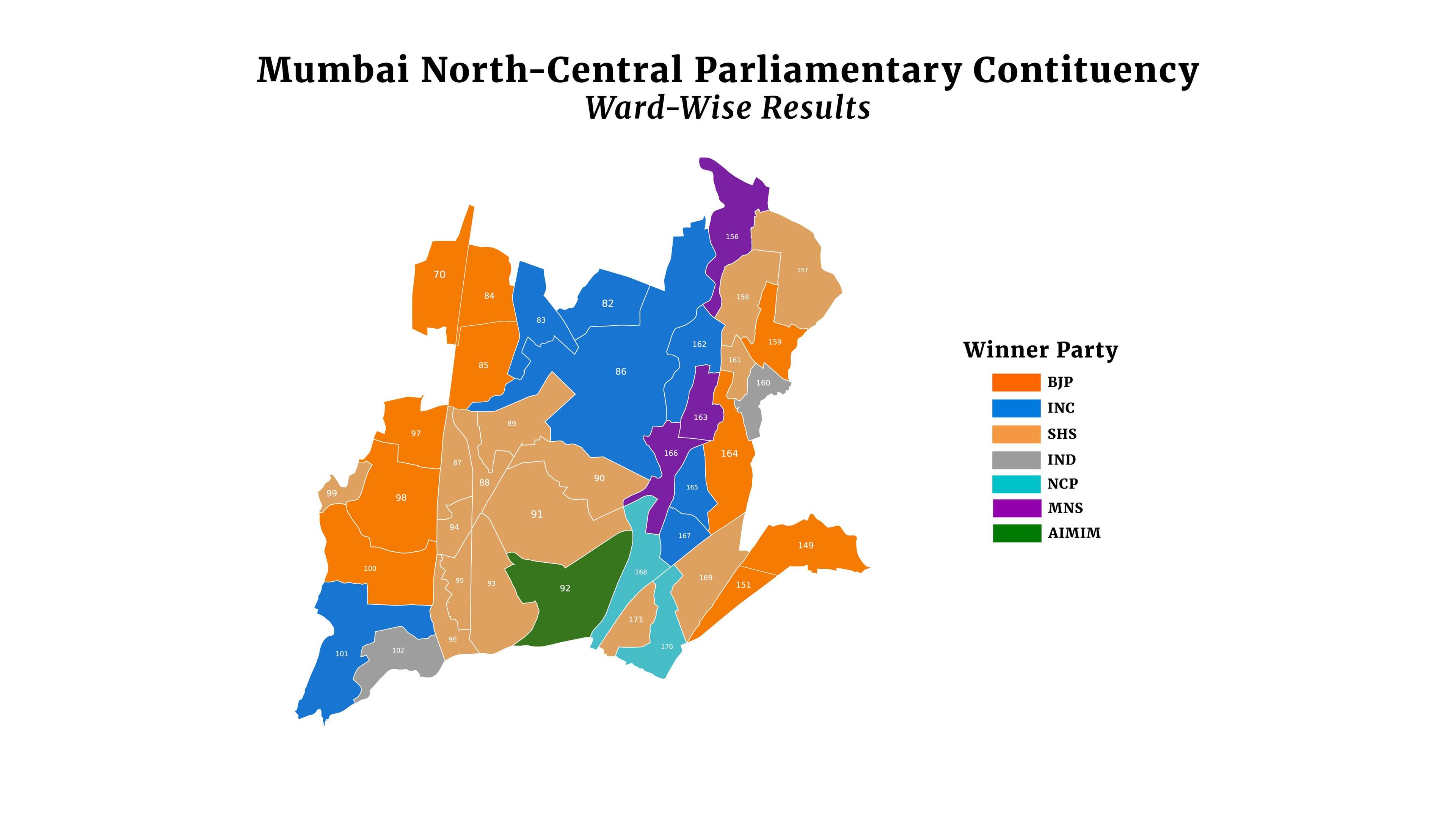
In AC’s like Kalina and Kurla, classic coalitional constituencies, outcomes hinge on vote consolidation. Kalina hinges almost entirely on Scheduled Caste vote behaviour. The BJP-SHS is organisationally weak here but can pick up one or two wards if RPI(A) splits the SC vote, otherwise INC or SSUBT benefit, making this one of the few regions where INC remains competitive. Kurla, in contrast, is governed by minority vote alignment. When consolidated, four wards can move together in favour of INC or SSUBT, fragmentation opens narrow entry points for BJP or SHS. In the Posh localities of Bandra, two AC’s Vandre East and Vandre West Showing completely different behaviours, Vandre East is largely status-quo driven, anchored by older Marathi voters and minority communities, with the SSUBT, INC, MNS, and NCP as the principal forces. Vandre West, however, is sharply urban in character. The BJP dominates most wards, with only two Muslim-majority wards remaining opposition-friendly. Chandivali and Vile Parle reflect long-term sociological drift rather than short-term shifts. Gujarati-Jain consolidation has reduced INC’s presence, leaving BJP or SHS as the default winners in most wards. Of the two, Chandivali remains more volatile, where urban-slum coexistence, minority influence, and multiple contenders shape outcomes through fragmentation rather than clear mandates, with small alliance shifts capable of changing results.
Mumbai North Central rewards vote discipline and management rather than popularity. Parties win here less by expansion and more by navigating fragmentation. The contest is likely to be evenly balanced, with an equal split of wards between the two major alliances, the BJP-SHS and the SSUBT-MNS. If the INC is able to split the SC-Muslim vote in some wards, the NDA alliance will gain an advantage.
Mumbai South Central presents a mix of clear strongholds and highly fragmented electoral spaces. It has a total of 35 wards across six Assembly Constituencies (ACs). Arithmetically, this is the strongest region for the SSUBT-MNS alliance. Anil Desai of the SSUBT is the Member of Parliament from this Parliamentary Constituency (PC), and the ACs are split evenly between the NDA and various INDI alliance parties.
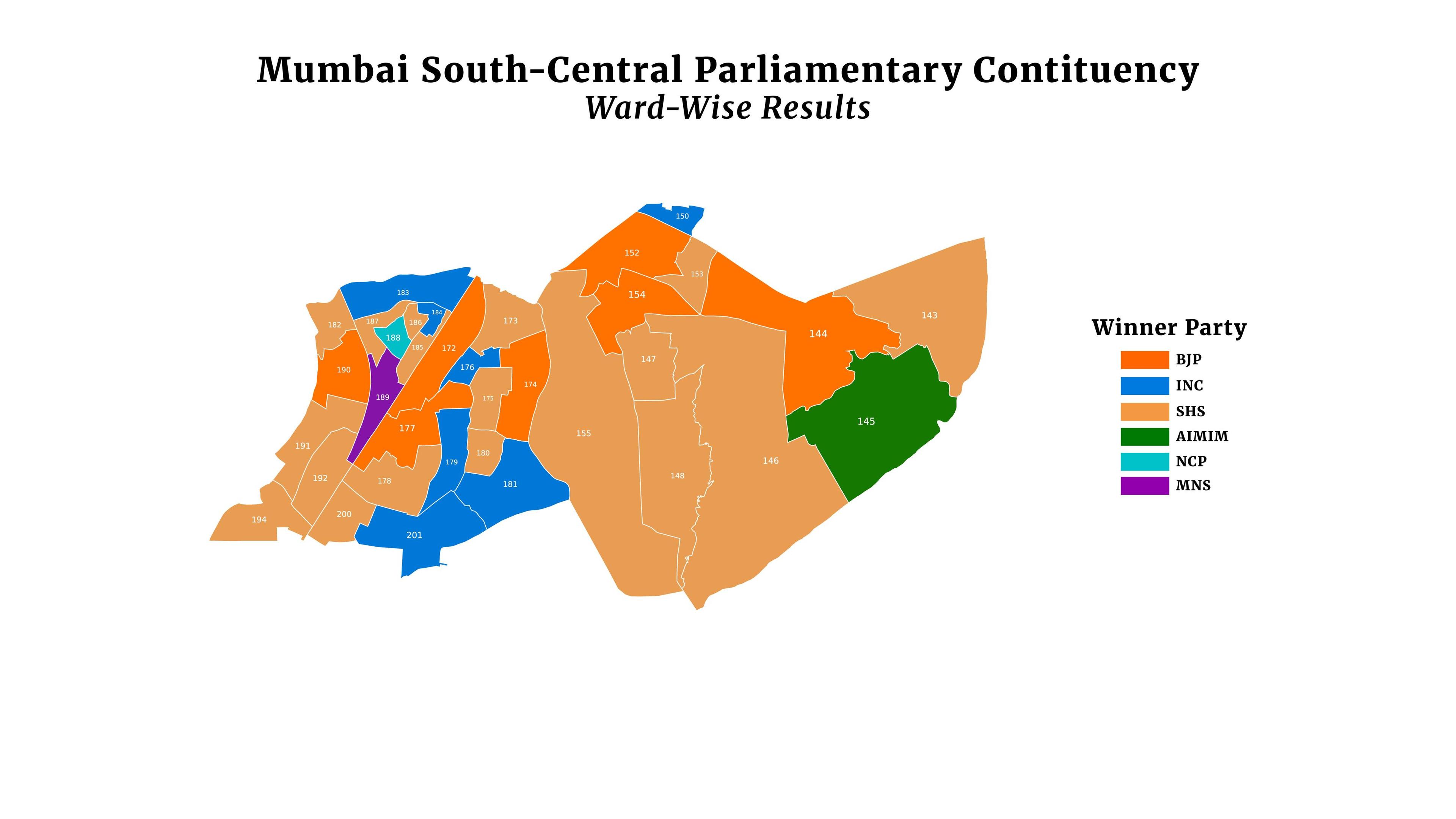
This region has traditionally been the heartland of the combined Shiv Sena, especially areas such as Mahim, Matunga, and Dadar, where old-guard Shiv Sainiks continue to hold influence. In most ACs, the contest is expected to be close between the two major alliances, with Mahim potentially delivering a clean sweep for the newly formed SSUBT-MNS alliance. Areas such as Dharavi, a reserved constituency shaped by a large Neo-Buddhist (Ambedkarite) base along with substantial Muslim and South Indian populations remain firmly INC-anchored and demographically restrictive for both the BJP and the SHS. Chembur stands out as the most settled assembly in this region, where BJP, alongside SHS, is well placed to sweep all wards with little effective resistance on the ground. Sion Koliwada and Wadala are expected to tilt clearly towards BJP. In Sion Koliwada, a 5-3 or even 6-2 split in BJP’s favour is a realistic scenario, while Wadala remains largely BJP-dominated with only limited opposition presence. Anushakti Nagar, meanwhile, is the most fractured assembly in this parliamentary constituency, with no single party in control and wards likely to be shared among BJP-SHS, NCP, and SSUBT-MNS mirroring Mumbai’s broader multipolar political trend.
Overall, Mumbai South Central rewards coordination and local control; without these, even strong parties struggle to convert presence into dominance. While the SSUBT-MNS alliance is expected to perform well in many wards, the overall split is likely to be 50-50, with the INC potentially capturing a share of the Scheduled Caste vote in Dharavi and Sion-Koliwada, making it harder for the SSUBT-MNS to register significant gains.
Mumbai South remains structurally difficult for BJP despite pockets of urban wealth, due to its dense minority and working-class voter base. Spanning six assemblies and 32 wards, outcomes here are shaped more by demographic ceilings than by campaign intensity. Arvind Sawant is a 3-term SSUBT MP from this region. This region marks a significant contrast between ultra HNI residential pockets and slum dwellers along with middle-lower income earners, especially chawls residents in Worli and Shivadi combined with minority pockets in Byculla and Colaba.
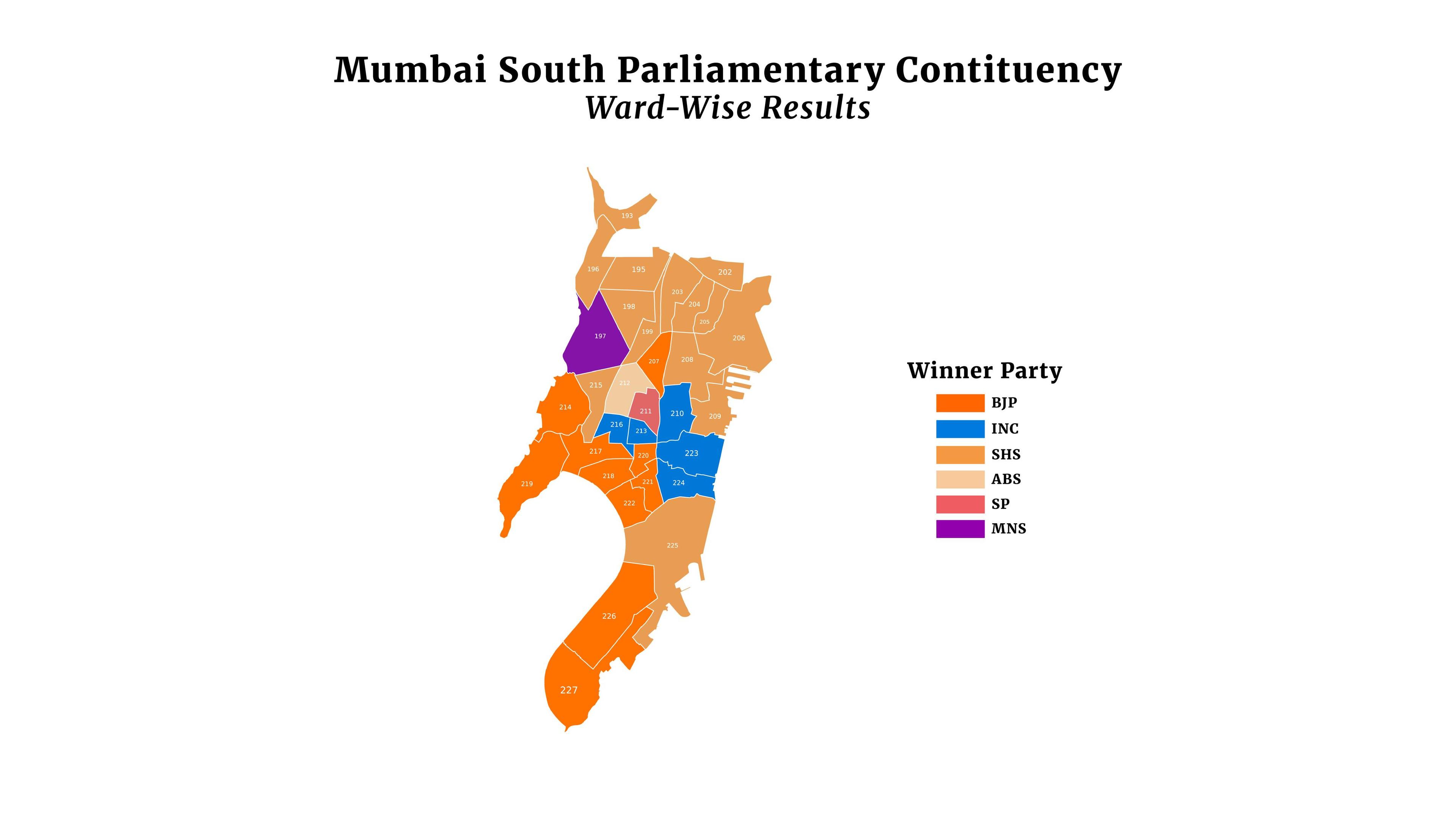
Byculla and Mumbadevi, both lower-income and Muslim-majority assemblies, remain anchored to the INC and the SSUBT, with the SHS limited to at most one or two wards. Malabar Hill and Colaba are clear exceptions: elite, urban, and dominated by largely North Indian populations, they deliver near-sweeps for the BJP. Milind Deora’s presence has added strength across South Mumbai, reinforcing the BJP in Malabar Hill and Colaba while also adding weight to the SHS in Worli, where he performed strongly against Aaditya Thackeray in the 2024 Assembly election.
Worli and Shivadi, meanwhile, reflect a different political logic. Both have a strong MNS presence rooted in Marathi and Koli voters, alongside a sizable Muslim population. The MNS and the SSUBT are well placed here, but neither can dominate outright, leaving outcomes dependent on how Marathi, Koli, and minority votes are distributed at the ward level.
Overall, Mumbai South is not ideologically anti-BJP but demographically restrictive. The BJP prevails where the social base permits it, not simply where effort or outreach is concentrated. The overall ward split is extremely hard to predict, with two plausible scenarios emerging: first, a BJP-SHS sweep of Malabar Hill and Colaba, with potential surprises in Worli, Shivadi, and Byculla through Hindu consolidation; second, a status quo outcome in which all 32 wards are split nearly evenly between the SSUBT-MNS and the BJP-SHS.
Taken together, the regional patterns point to a simple but often misunderstood reality: BMC elections are not decided by waves, personalities, or headline popularity. They are decided by architecture and the slow, granular mechanics of how votes are distributed, split, and consolidated at the ward level.
Mumbai does not reward broad political momentum, it rewards parties that can manage fragmentation, convert marginal advantages into ward victories, and sustain local organisational presence over time. Even dominant parties rarely sweep regions outright; instead, power is accumulated incrementally one ward at a time, often on narrow margins.
Any party approaching the next BMC election without internalising this reality is not preparing for Mumbai as it exists on the ground. It is preparing for a simplified version of the city, one that looks coherent on paper, but does not survive contact with ward-level politics.