Politics
Article01/13/2026
Mumbai’s Political Mosaic: A Regional Reading of Mumbai’s Civic Polls
Few regions in India have witnessed political change as dramatic as West Bengal. For over three decades, the state was a stronghold of Left ideology; today, it is a highly competitive arena marked by sharp electoral shifts.
Phase 1: The Era of Left Dominance (1977–2009)
From 1977 to 2009, West Bengal was governed by the Left Front, led by the Communist Party of India (Marxist) (CPIM). During this period, the Left consistently secured around 45–50% of the vote, while opposition space was largely occupied by the Indian National Congress (INC) and, after 1998, the All India Trinamool Congress (AITC). This long phase of CPIM stability was underpinned by strong rural support, land reforms, and a class-based political narrative, resulting in relatively low electoral volatility and durable voter alignments.
Phase 2: The Rise of the Trinamool Congress (2009–2016)
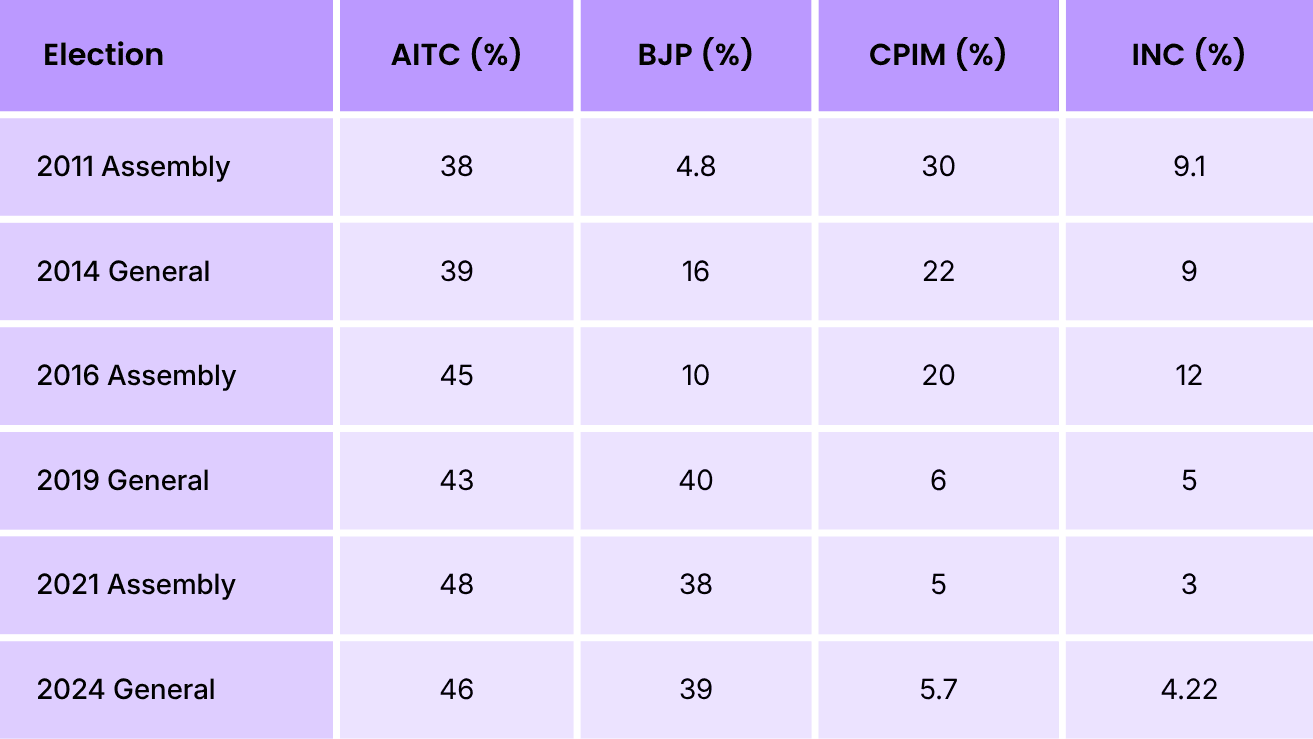
The late 2000s marked a decisive break from Left dominance as AITC, led by Mamata Banerjee, emerged as the principal challenger. The 2009 General election (hereafter GE) signaled this shift, which culminated in the 2011 Assembly election (hereafter AE) that ended 34 years of Left rule, with vote shares of approximately 38% for AITC, 30% for CPIM, 9% for INC, and 4.8% for the Bharatiya Janata Party (BJP). By 2014 GE, AITC consolidated its position with about 39% vote share, while CPIM declined to roughly 22%, INC remained near 9%, and BJP rose to around 16%. Overall, AITC and its allies stabilized in the 35–40% range, while the Left’s support fell to about 20–22%. This transition was driven by mobilization around land conflicts such as Singur and Nandigram, alongside a broader shift from cadre-based ideological politics to a more leader-centric model.
Phase 3: The Bipolar Contest and the Rise of BJP (2016–Present)
In West Bengal, the post-2016 phase marks a clear transition to a bipolar contest between the AITC and the BJP, driven by sharp numerical shifts in vote shares. BJP’s rise is particularly striking: from ~10% in the 2016 AE, it surged to ~40% in the 2019 GE, an increase of about 30 percentage points (roughly a fourfold jump). It then retained a high base with ~38% in 2021 AE and ~39% in 2024 GE, indicating consolidation rather than decline. In contrast, AITC’s vote share has remained relatively stable, moving from ~45% (2016 AE) to ~43% (2019 GE), rising to ~48% (2021 AE), and settling at ~46% (2024 GE), reflecting a narrow fluctuation band of about ±3 percentage points.
At the same time, the decline of the CPIM and the INC is evident in the numbers. CPIM’s vote share dropped from ~20% in 2016 to ~6% in 2019 (a fall of 14 percentage points), and further stagnated around ~5–6% in 2021 and 2024. Similarly, INC declined from ~12% in 2016 to ~5% in 2019 (down 7 percentage points), and further to ~3–5% thereafter. These shifts suggest that over two-thirds of the CPIM's 2016 vote base migrated to the BJP, while a smaller segment moved toward AITC. Meanwhile, INC’s erosion appears to have benefited AITC more than BJP, with only marginal transfer to the latter. Overall, the data clearly indicates that BJP’s growth has been fuelled primarily by the collapse of CPIM support, leading to the consolidation of a competitive two-party system in the state.
1. AITC's stronghold on women voters:
The AITC has maintained a stronghold on women voters. Over the years, it introduced targeted welfare schemes such as Lakshmir Bhandar, Rupashree, and Kanyashree, which helped consolidate its support base among women and contributed to its consistent electoral performance.
2. Shift in SC/ST voting patterns and BJP's emergence in West Bengal:
The rise of the BJP in West Bengal has been partly linked to its growing support among Scheduled Caste (SC) and Scheduled Tribe (ST) communities, especially in regions like North Bengal and Jangalmahal. The erosion of CPIM's traditional support base among these marginalized groups created an opening that the BJP capitalized on by mobilizing non-dominant caste identities and grievances. This shift was reinforced by political polarization and local discontent, enabling the BJP to convert sections of SC/ST voters, who earlier aligned with the CPIM, into a crucial component of its expanding vote base.
3. Regional variation matters:
Post-2016, the contest has consolidated into a bipolar competition primarily between the AITC and the BJP, with the Left and Congress experiencing a sharp decline in electoral relevance.
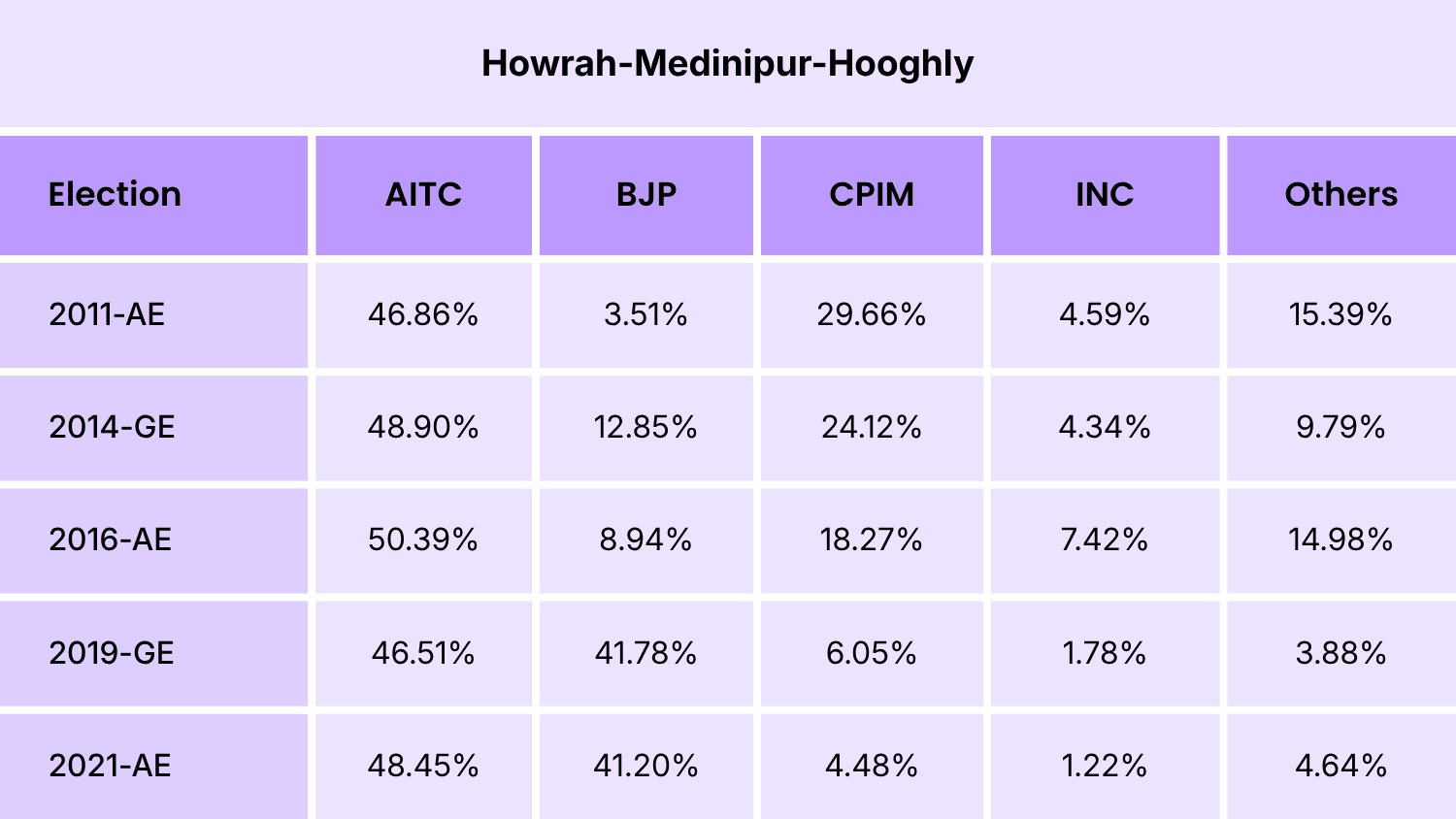
Voting patterns across the state are far from uniform, with distinct regional variations. In the Howrah–Medinipur–Hooghly belt, AITC’s performance has remained relatively stable over time, recording vote shares of 46.86% (2011 AE), 48.90% (2014 GE), 50.39% (2016 AE), 46.51% (2019 GE), and 48.45% (2021 AE). In contrast, BJP’s vote share in this region surged dramatically from 3.51% in 2011 to 12.85% in 2014, dipped slightly to 8.94% in 2016, and then spiked to 41.78% in 2019, before stabilising at 41.20% in 2021.
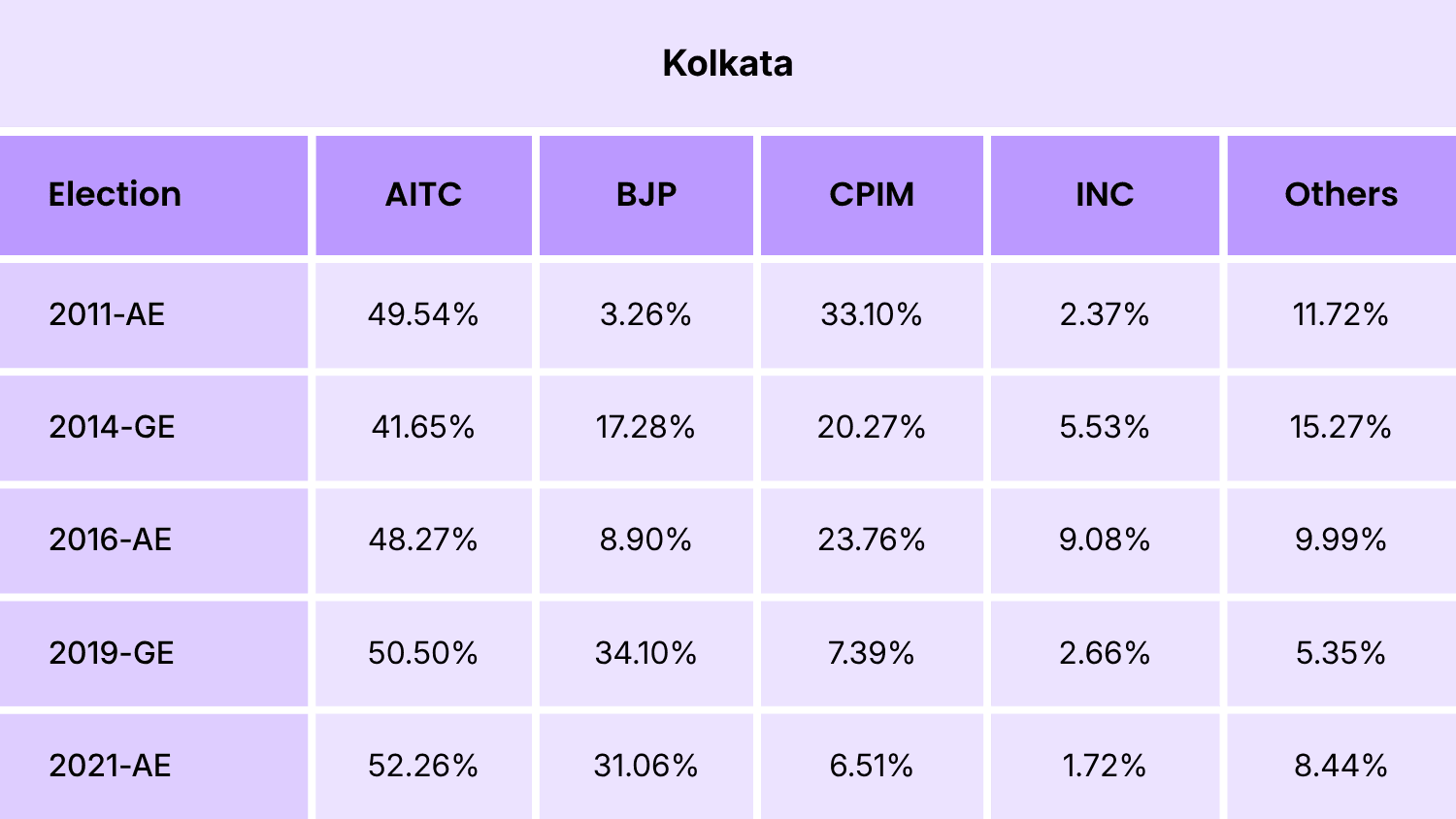
A similar but distinct trend is visible in the Kolkata metropolitan region (including the North and South 24 Parganas). Here, AITC’s vote share evolved from 49.54% (2011 AE) to 41.65% (2014 GE), then rebounded to 48.27% (2016 AE), rising further to 50.50% (2019 GE) and 52.26% (2021 AE). BJP, on the other hand, increased its vote share from 3.26% in 2011 to 17.28% in 2014, fell to 8.90% in 2016, and then sharply rose to 34.10% in 2019 before declining slightly to 31.06% in 2021.
These trends highlight two key dynamics. First, AITC has maintained a relatively consistent vote base across regions, with only moderate fluctuations. Second, BJP’s rise particularly between the 2016 Assembly and 2019 General elections has been steep but uneven. For instance, in the Howrah–Medinipur–Hooghly region, BJP’s vote share increased by more than four times between 2016 and 2019, while in the Kolkata region, it rose by nearly three times during the same period, followed by a slight decline in 2021.
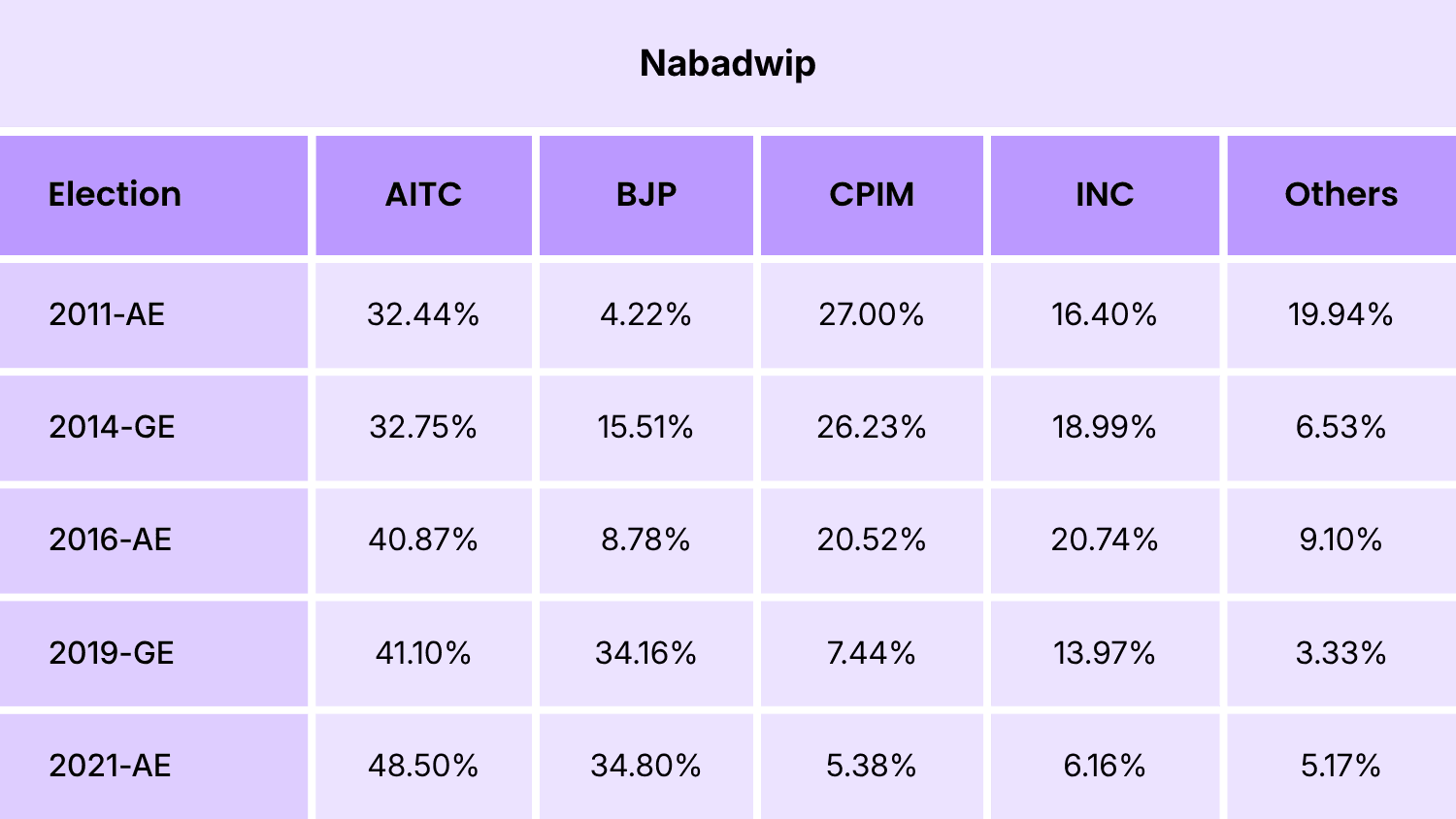
Overall, while BJP has expanded its electoral footprint across West Bengal, this growth has not been homogeneous. The scale and sustainability of its gains vary significantly across regions, underscoring the importance of localised political dynamics in shaping electoral outcomes. The regional split of vote shares across the past five elections is shown below. BJP has progressively gained ground, while AITC has maintained its hold across all major regions. North Bengal remains a BJP stronghold while HHM and Kolkata have shown reluctance for change thus far.
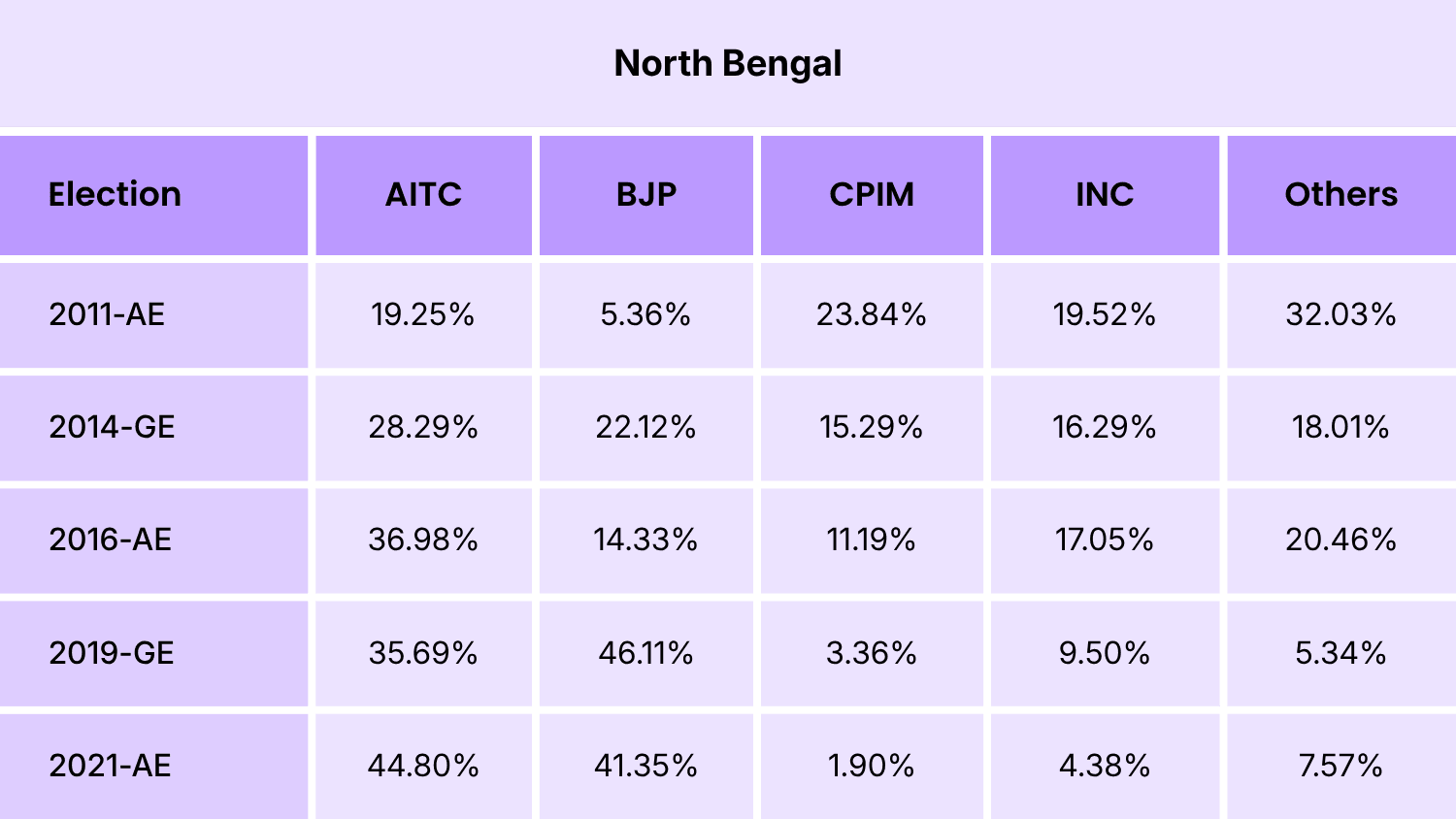
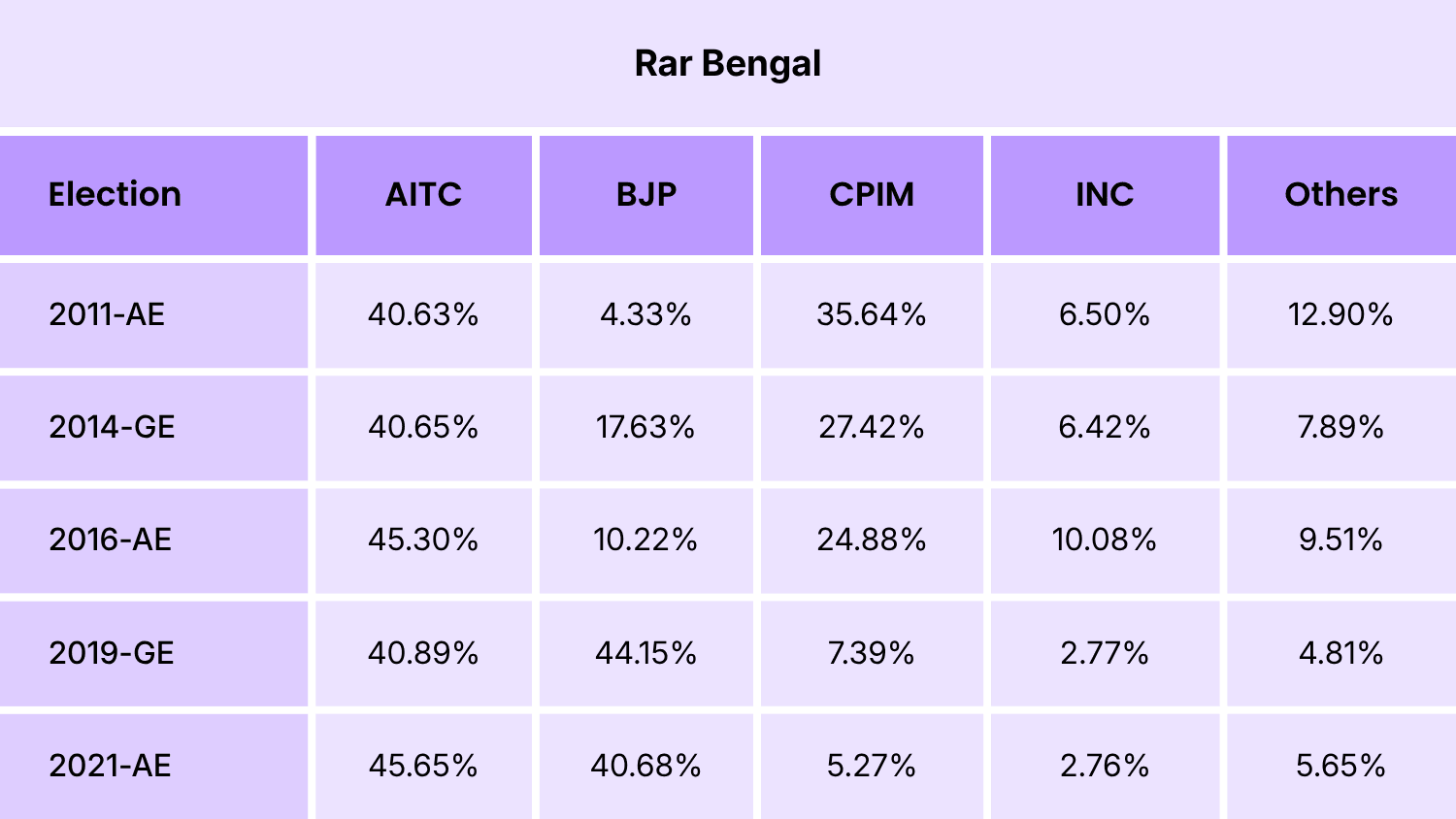
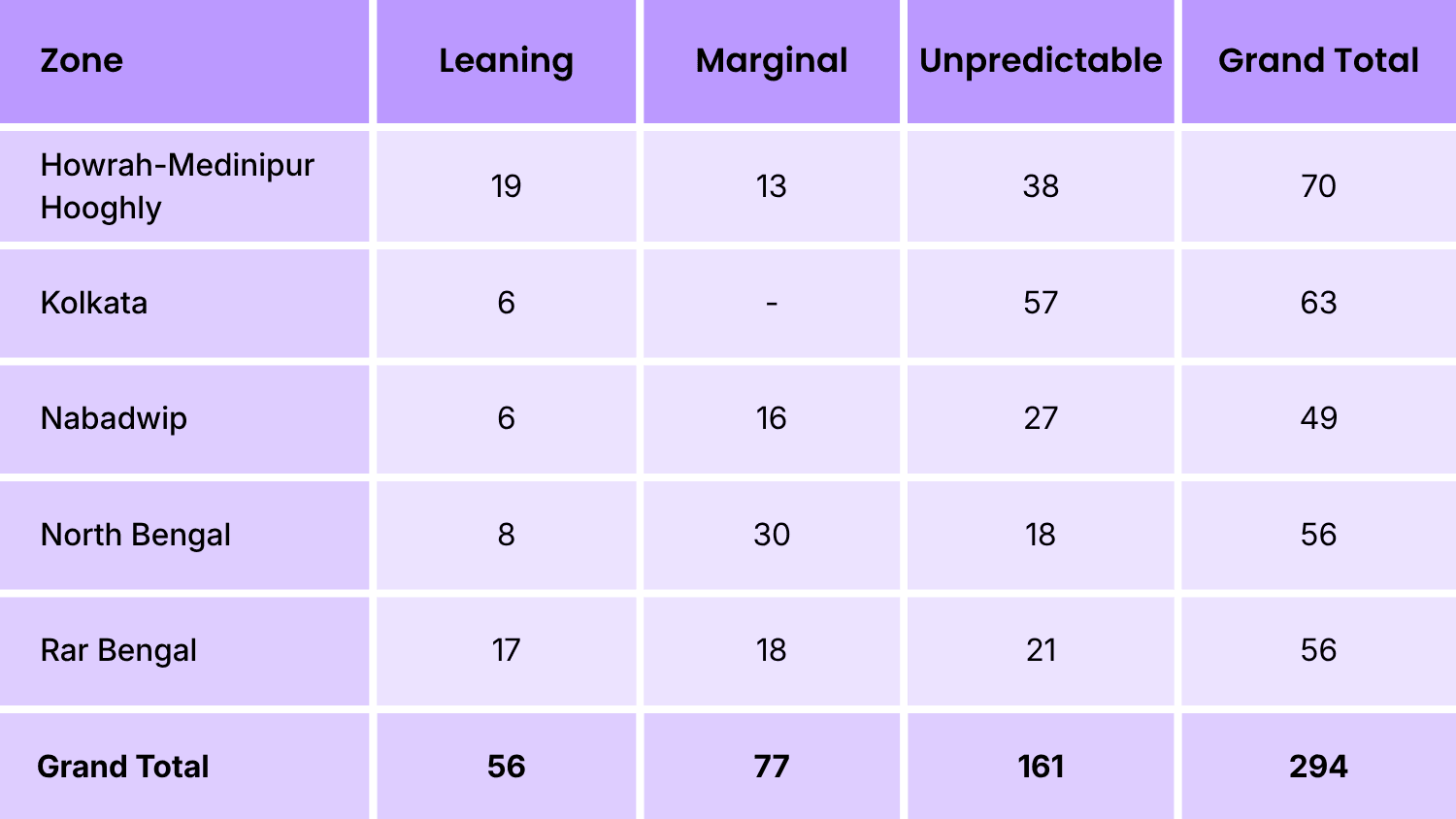
The table below illustrates zonal strongholds across party lines. The majority of 294 ACs have had a different winner at least once since 2011 while only 56 can be considered strongholds.